
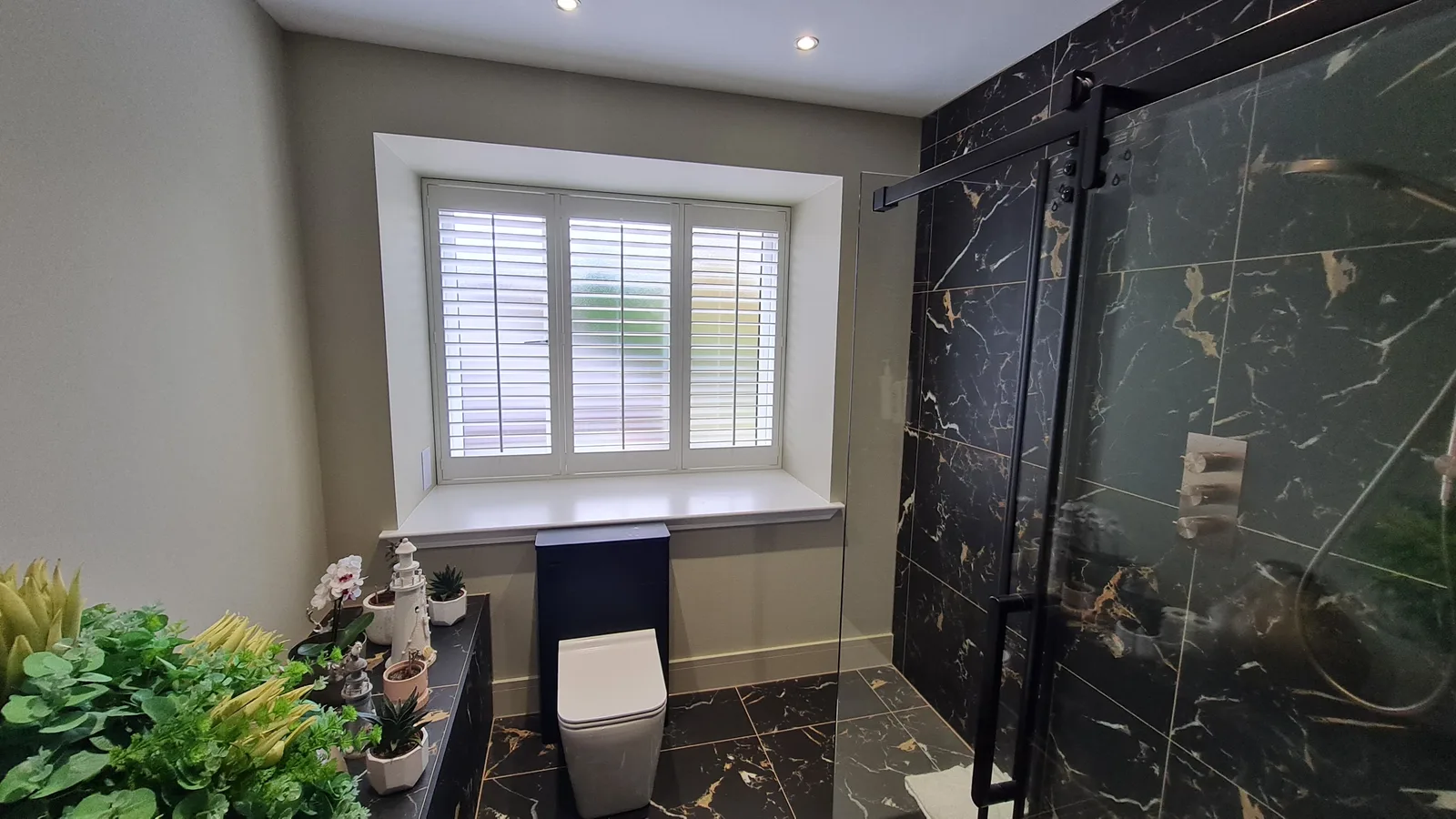
When 'Waterproof' Shutters Aren't Waterproof
If you’ve shopped for shutters online, you’ll have noticed that almost every plastic shutter on the market is described as “waterproof,” “water-resistant,” “fully waterproof,” or some variant of the same idea. The implication is clear: if you’ve got a bathroom, kitchen, wetroom, or anywhere else with humidity in the air, these shutters will laugh off the moisture and last forever.
It’s a great marketing line. It’s also, for a large chunk of the market, quietly misleading.
The truth is that there’s a meaningful difference between a material that doesn’t absorb water and a finished product that keeps water out. Cheap vinyl shutters being sold as “waterproof” can fail this distinction in a way that the Design Studio doesn’t reveal until you’ve lived with them for a couple of years. Here’s what’s actually going on.
A Material Isn’t a Product
Let’s start with the science, because it matters.
PVC, the vinyl in cheap vinyl shutters, is, in its raw form, genuinely impervious to water. Water won’t soak into a piece of solid PVC the way it would soak into untreated timber or untreated MDF. That much is true, and it’s the bit of the marketing claim that’s technically defensible.
What the marketing doesn’t tell you is that a vinyl shutter panel is not a single piece of solid PVC. It’s an assembly. The stiles (the vertical sides), the rails (the horizontal top and bottom), and often the louvres themselves are typically manufactured as hollow extruded sections, the same way PVC window frames, gutters, and conduit are made. These hollow tubes are then cut to length, jointed at the corners, and pinned, glued, or fastened together to form the panel you see on display.
That panel looks solid. It usually isn’t. Inside the stiles and rails are long, hollow chambers, sometimes a single chamber, sometimes a multi-cell structure. And every joint between every component is a potential point of entry for moisture.
How Water Can Get Inside a “Waterproof” Shutter
Once you understand the hollow construction, the mechanism becomes obvious.
In a high-humidity room, a bathroom during a hot shower, a kitchen during cooking, a conservatory in damp Scottish weather, warm moist air is everywhere. It works its way into every gap and seam in the room, including the joints of any furniture or fittings made up of multiple parts. When that warm air reaches a cooler surface, it condenses into liquid water.
On a vinyl shutter, that cooler surface can be the inside of the hollow chamber. The corner joint, the small gap where the louvre pivot pin enters the stile, the cut end of a rail where the end-cap doesn’t quite seal, all of these can provide a route for humid air to enter the cavity. Once inside, that air cools, condenses, and can leave liquid water sitting on the inner surfaces of a structure that has no drainage and no ventilation.
Add a few months of repeated cycles, warm shower in the morning, cool bathroom by lunchtime, warm shower again that evening, and you can end up with stagnant moisture inside a sealed plastic chamber.
You can probably guess what happens next.
The Smell That Tells the Story
Here the science is unambiguous. The plasticisers used to make PVC flexible, typically phthalate esters like DEHP and DOA, are themselves a food source for certain bacteria and fungi. Peer-reviewed research published in Applied and Environmental Microbiology and other journals documents that “the susceptibility of plasticised PVC results from the presence of plasticisers, commonly organic acid esters… Both bacteria and fungi can degrade ester-based plasticisers.” The same body of research notes that microbial degradation of pPVC results in brittleness, shrinkage, and ultimately failure of the material.
The PVC industry is well aware of this. Major manufacturers of vinyl flooring and PVC building products now sell antimicrobial-treated versions specifically to combat the problem.
In a hollow shutter component with internal moisture, the microbes would have everything they need: warmth, moisture, organic material, and complete absence of light or ventilation. The growth happens out of sight, inside the chambers of stiles and rails the homeowner has no way to inspect.
You don’t see it. You smell it.
The first sign tends to be a faintly musty odour, particularly noticeable on warm days when shutters heat up and any moisture inside is driven into the room as vapour. Owners often blame the bin, the drains, the carpet, even the family pet. By the time anyone connects the smell to the shutters, the contamination is well-established and there’s no practical way to clean inside the panels.
We’ve had customers come to us specifically because they’d reached this point with another supplier’s product, and the only resolution was to remove and replace the shutters entirely.
Why Our ABS Ranges Don’t Have This Problem
It’s worth being precise about which plastic shutters this issue affects, because it isn’t all of them.
Our S:Craft Java range is manufactured from high-grade ABS, not vinyl, and it’s built to a fundamentally higher standard of construction. S:Craft describe it as “100% water resistant” and “fully moisture resistant,” and they market it specifically into bathrooms, kitchens, and rooms with condensation, exactly the use case where the cheap vinyl products tend to fall over. Our Custom West Hollywood range, supplied through Luxaflex, is also ABS, with the manufacturer making a direct claim of “superior strength to prevent warping, denting and chipping.”
In our installation history across central Scotland, we have no record of moisture-related failure on either of these ranges. They are designed and sealed differently from the bargain vinyl product sold by online retailers, and the difference shows up after a few years in service.
This is the point we made in our previous article on heat warping, and it bears repeating: the word “plastic” covers a huge range of products of vastly different quality. A high-grade ABS shutter from a reputable manufacturer behaves nothing like a cheap hollow vinyl shutter from a discount website. They look similar in the Design Studio. They behave nothing alike two summers in.
What to Ask Before You Buy
If you’re shopping for shutters for any humid room and a supplier is offering you a “waterproof” plastic product, three questions will tell you most of what you need to know:
- “Which grade of plastic is this, and what density?” A confident, specific answer is a good sign, whether the answer is ABS or a dense high-stability PVC. Vague answers (“it’s plastic,” “it’s faux wood,” “it’s a composite”) are the warning, not the polymer itself.
- “How thick is the wall of the stile, and how is every corner joint and end cap sealed?” This is the question that separates a well-made plastic shutter from a bargain one. Thin walls and open, unsealed joints are the configuration most prone to water-ingress problems, whatever the polymer. A manufacturer who knows their product will answer it without hesitating. A discount retailer usually cannot.
- “What does the warranty actually cover?” “Waterproof” claims often come with warranties that exclude “discolouration,” “odour,” or “internal staining,” the precise failures we’ve described above. If the warranty has those exclusions, the manufacturer knows what can go wrong.
A reputable supplier will be perfectly comfortable answering all three. A retailer who can’t, or who deflects, is telling you everything you need to know.
There is in fact a fourth question we’d now add to that list, on the chemistry of what’s inside a cheap PVC shutter and what it may be releasing into your air when the sun warms it up, but that’s a topic substantial enough to deserve its own article.
Continue Reading: The Final Piece of the Puzzle
This is one of four articles investigating the most common problems we see with budget shutters across Scotland. The other three tackle related but separate issues:
→ When Shutters Bow to the Sun, what cheap vinyl actually does on a south-facing window.
→ The Hidden Risks of Perfect Fit® Shutters, why the no-drill clip-fit system can put your double-glazing warranty into dispute.
→ The Chemistry No One Wants to Talk About, the peer-reviewed research on what happens to plasticised PVC when it sits in direct sunlight.
Or read the full guide at Plastic Shutters: What You Actually Need to Know.
Why Choose The Scottish Shutter Company
We’ve been fitting shutters across Edinburgh, Dundee, and central Scotland for almost forty years, and we work with manufacturers who are happy to give us clear answers about how their products are built. That matters because we’re the ones who’ll be back at your door if anything goes wrong, and our reputation is staked on the fact that it rarely does. As full members of the British Blind and Shutter Association, our Technical Director David D’Ambrosio is the BBSA’s go-to expert on shutters and a Past President of the Association. We know what good practice looks like in this trade, and we know what poor practice looks like too.
For bathrooms, kitchens, wetrooms, and any other room where moisture is part of daily life, we’ll typically recommend either S:Craft’s Java range or Custom West’s Hollywood range, both ABS, both properly engineered for humid environments, both with installation track records we can stand behind. For other rooms, we’ll talk you through hardwood and engineered wood options that suit your aesthetic and your budget.
What we won’t do is sell you a “waterproof” product on the strength of a marketing claim that doesn’t survive contact with reality.
Ready to Get It Right First Time?
If you’re considering shutters for a bathroom, kitchen, or any other humid space, and especially if you’ve been quoted by someone whose answers to the three questions above were a bit thin, we’d love to help you make a properly informed decision.
Contact us today for a free in-home consultation or download our brochure for a closer look at our full range of genuinely durable shutters for humid environments.
Get it right once, and you won’t need to think about it again.

Inspired by what you've read?
Request a brochure or arrange a no obligation consultation.