
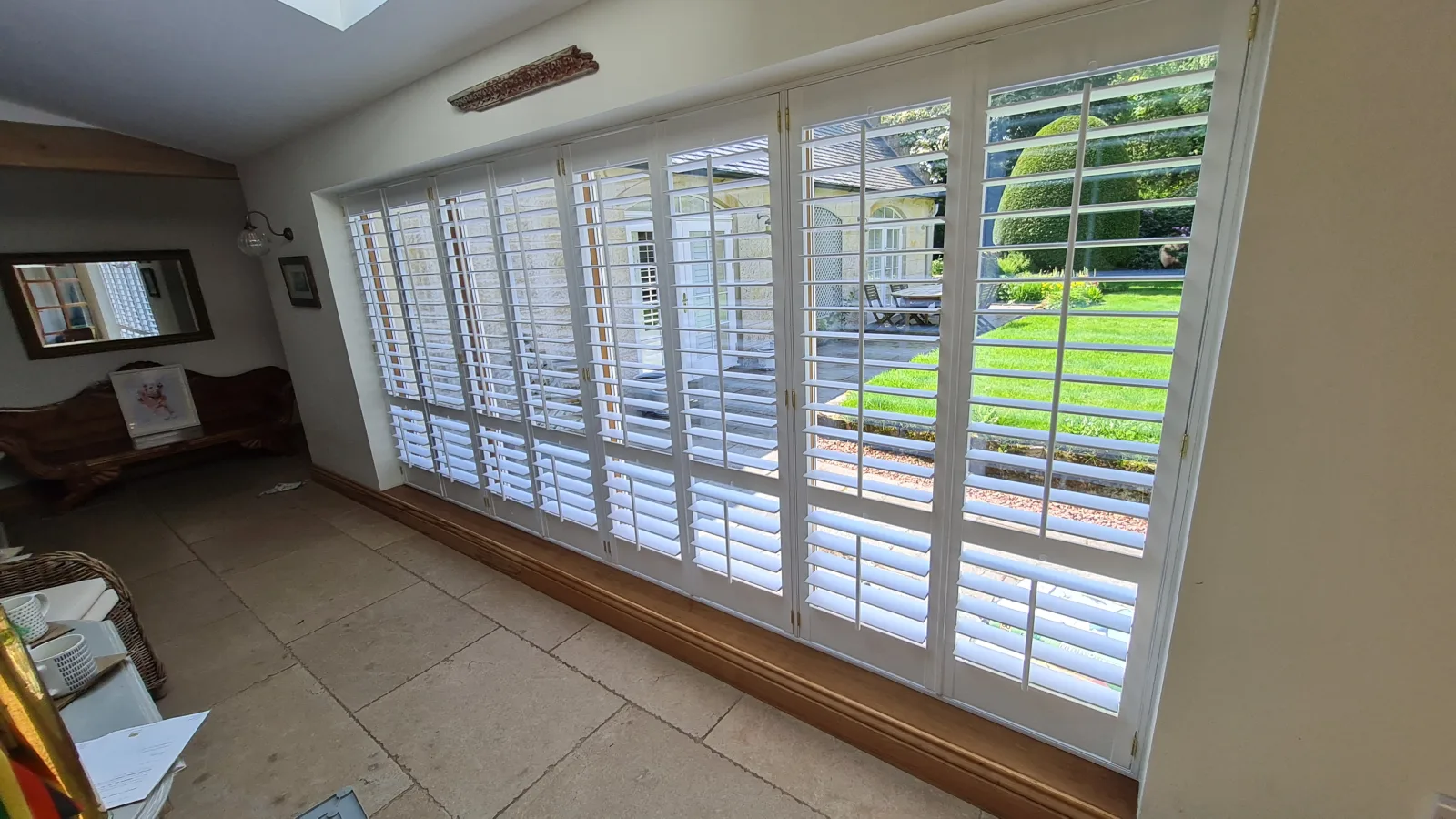
The Chemistry No One Wants to Talk About: What Heated PVC Shutters May Be Releasing Into Your Home
We’ve spent three previous articles in this series looking at the visible problems with cheap plastic shutters: how they warp on south-facing windows, how Perfect Fit® installations risk damaging your glazing, and how “waterproof” vinyl panels can develop hidden moisture and mould inside their hollow construction.
This article is about something you can’t see, can’t easily measure, and almost certainly haven’t been told about by anyone trying to sell you cheap shutters.
It’s about what happens to the chemistry of a PVC shutter when it sits in direct sunlight, particularly when it’s installed close to the glass. And the science is more striking than even we expected when we started researching it.
A word before we begin: we’re not here to scaremonger. We sell two ranges of ABS plastic shutters ourselves (S:Craft’s Java and Custom West’s Hollywood, available through Luxaflex), and we’ll explain later why they sit in a fundamentally different category. What follows applies specifically to plasticised PVC and unbranded vinyl shutters, the kind sold cheaply online by retailers who often won’t or can’t tell you exactly what’s in them.
A Quick Primer: What’s in a PVC Shutter
Polyvinyl chloride, PVC, in its raw form is a hard, brittle plastic. To turn it into something flexible and workable enough to be made into shutter louvres, flooring, shower curtains, or food packaging, manufacturers add plasticisers: chemical compounds that sit between the PVC molecules and let them slide past each other.
The most common family of plasticisers is phthalates, and one of the most heavily used members of that family is DEHP, di-(2-ethylhexyl) phthalate. DEHP and several related phthalates (DBP, BBP, DIBP) have been classified by both the EU and UK chemical regulators as endocrine disruptors and reproductive toxicants, meaning they interfere with the body’s hormone system at low doses.
Under UK REACH regulations (the post-Brexit version of the EU’s chemical safety framework), these four phthalates have been restricted in articles containing plasticised materials to a maximum of 0.1% by weight individually or in combination since July 2020. In theory, any plasticised product legally sold in the UK should comply with that limit.
In practice, enforcement of these limits in imported consumer products is uneven. Phthalates remain among the most frequently flagged chemicals in EU and UK consumer-product safety alerts, with non-EU imports making up a disproportionate share of non-compliant cases. The cheap end of the shutter market, unbranded imports sold through marketplace listings with vague material descriptions, sits squarely in the higher-risk category.
So that’s the first issue. Cheap “vinyl” or “faux wood” shutters being sold for £100 a panel may or may not actually meet UK chemical safety standards, and you have no straightforward way of knowing.
The Second Issue: Heat Changes Everything
Here is the fact we found most striking in our research, and it’s worth pausing on.
Researchers at Denmark’s National Research Centre for the Working Environment, publishing in 2012 in the American Chemical Society’s peer-reviewed journal Environmental Science & Technology, measured DEHP emissions from PVC flooring (containing 13% DEHP by weight as plasticiser) at five different temperatures: 23°C, 35°C, 47°C, 55°C, and 61°C.
What they found is that gas-phase DEHP concentrations climbed from 0.9 µg/m³ at 23°C to 198 µg/m³ at 61°C, roughly a 220-fold increase over that temperature range.
More directly relevant to real-world conditions, the authors themselves concluded that with an increase of temperature in a home from 23°C to 35°C, the amount of DEHP in the gas- and particle-phase combined is predicted to increase almost 10-fold.
Note carefully what this study measured: PVC flooring, not PVC shutters specifically. We have not located a peer-reviewed study that has directly measured emissions from a PVC shutter. The 13%-DEHP-by-weight composition of the flooring tested is broadly similar to what is reported in the wider PVC consumer-product literature, and PVC shutters that contain phthalate plasticisers would be expected to behave similarly, but we want to be upfront that we are applying the principle of the research rather than citing direct measurement of the specific product type.
What the science is unambiguous about is the direction and magnitude of the temperature dependency. Phthalates aren’t chemically bonded to the PVC, they sit between the molecules, held in place by weak intermolecular forces. As temperature rises, those molecules vibrate more energetically, and the phthalates escape more readily into the surrounding air. Every plastic that contains plasticisers, and every plastic that contains residual manufacturing chemicals, behaves this way to some degree. PVC, with its high plasticiser load, is one of the most temperature-sensitive offenders.
How Hot Do Shutters Get?
This is where the geometry of installation becomes critical.
Dr Andrew Marsh, a building physicist specialising in building performance simulation, documents in his published technical writing that the air gap between an internal blind or shutter and the window glass it covers can reach temperatures up to 20°C higher than the average internal air temperature when the shutter is in direct sun. This is well-known among glazing engineers and is one of the reasons published guidance recommends maintaining at least 50mm clearance between internal window coverings and the glass surface to allow air movement and prevent heat build-up, the same 50mm rule we discussed in our previous article on Perfect Fit® shutters.
Run that through some realistic Scottish summer numbers:
- Average internal room temperature in summer: 22°C
- Air gap temperature behind a shutter in direct sun: up to 42°C (room temperature + 20°C, per Marsh)
- The louvre surface itself: typically hotter still, because it’s absorbing solar energy directly. We haven’t been able to find peer-reviewed measurements specifically for interior-shutter louvre surface temperatures, but the principle is identical to the well-established physics of any sun-facing dark or coloured surface behind glass.
Take Marsh’s 20°C-above-ambient figure for the air gap. Apply Clausen’s 10-fold-emissions-increase-from-23°C-to-35°C finding. You don’t need a multiplier of 220 to make the point: if a PVC shutter is sitting in 35-42°C air for hours of the day, with phthalate emissions multiplying as the temperature rises, the cumulative load into the room is going to be many times what the same shutter would emit at room temperature.
That’s the chain of physics. And it’s measurable, not theoretical.
Why Perfect Fit® Shutters Are Particularly Concerning
In our earlier article on Perfect Fit® shutters, we noted that these clip-fit products sit unusually close to the glass, well inside the 50mm clearance zone that glazing engineers recommend for thermal stress reasons.
What we didn’t say in that article, because we hadn’t yet researched this angle, is that proximity to the glass also means proximity to the hottest air in the room. A Perfect Fit® shutter in direct sun is sitting in the warmest possible position, with the worst possible ventilation, made (in many cases) from the very material that emits exponentially more chemicals as temperature rises.
If the same shutter is then made from cheap, potentially non-compliant PVC sold through an online retailer that can’t tell you what’s in it, well, you can join the dots yourself.
Why Our ABS Ranges Are Different
We’re not anti-plastic. We sell two ABS plastic ranges, both of which we’ve fitted across central Scotland for years without issue. The distinction matters, so let’s be precise about why ABS is fundamentally different from plasticised PVC.
ABS, acrylonitrile butadiene styrene, is a thermoplastic that’s rigid by nature. It doesn’t need plasticisers to be workable, because it’s already in a form that can be moulded and extruded into the shapes we need. You’ll find ABS in Lego bricks, motorcycle helmets, car dashboards, and medical equipment, much of which lives at high temperatures for years without harm. Crucially, ABS contains no phthalates in its standard formulation, because there’s nothing to plasticise.
That doesn’t mean ABS is chemically inert, no plastic is, and trace emissions of compounds such as styrene can occur from ABS, particularly when freshly manufactured. But the emission profile is fundamentally different from plasticised PVC, the temperature dependency is far less pronounced, and the specific compounds involved are not the endocrine-disrupting phthalates that have driven a decade of UK and EU regulatory action against plasticised PVC.
S:Craft and Custom West are both established manufacturers selling into the regulated European and UK markets. Their products are subject to UK REACH compliance. We can stand behind what we sell.
The same simply cannot be said for an unbranded “faux wood” shutter shipped directly from an online marketplace listing.
What This Means in Practice
We want to be measured about this. We are not claiming that every cheap PVC shutter in the UK is making people ill. The science describes a risk pathway based on PVC flooring research extrapolated to a similar product, not a guaranteed outcome, and individual responses to environmental chemical exposure vary enormously.
What we are saying is this:
-
Cheap PVC shutters typically contain plasticisers. Some of those plasticisers are restricted under UK law for very good reasons. Compliance among unbranded imports is uneven and documented.
-
Heat substantially accelerates the release of plasticisers into the air. The peer-reviewed research on PVC flooring is unambiguous on this, with emissions rising by approximately 10-fold over a temperature rise from 23°C to 35°C in real-home conditions.
-
The closer the shutter sits to the glass, the worse this gets. Perfect Fit® installations, conservatory installations, and any south-facing room with poor ventilation create the highest-temperature, highest-emission environment.
-
You can avoid the whole question by choosing a different material. Real hardwood, properly finished, doesn’t have this problem. ABS shutters from reputable manufacturers have a fundamentally different and much lower emission profile. The choice is yours.
If you’ve already got cheap PVC shutters fitted and you’re now worried, the practical mitigations are simple: open your windows regularly, particularly on warm days; keep the shutters open when the sun is on them (so the louvres aren’t cooking in a sealed cavity); and consider replacement with a better material when you next refurbish the room.
A Note on the Limitations of This Research
We want to be completely clear about what we know and don’t know.
The temperature-dependent emissions data we’ve cited comes from peer-reviewed studies of PVC flooring, not PVC shutters specifically. We have applied the principle to shutters on the basis that the underlying material (plasticised PVC) and the underlying physics (temperature-driven phthalate emission) are the same, and that PVC shutters are exposed to higher temperatures than flooring ever is.
What we can say with confidence: the regulatory framework (UK REACH) is real and current; the temperature-emissions relationship for PVC plasticisers is well-established science; the temperature behind a sun-facing internal shutter is documented; and the ABS material used in our Java and Hollywood ranges does not contain phthalate plasticisers as a structural ingredient.
What we cannot say: precisely how much DEHP is being emitted by any specific PVC shutter on any specific Scottish window. Anyone offering you a number with confidence is overstating what the published research supports.
The Four Questions to Ask Any Shutter Retailer
In our previous article on “waterproof” vinyl shutters, we suggested three questions every customer should ask before buying. We’ll add a fourth here:
- Is this product ABS or PVC?
- How thick is the wall of the stile, and how is every corner joint and end cap sealed?
- What does the warranty actually cover?
- Can you confirm that the plasticisers used in this product comply with UK REACH limits for phthalate content?
A reputable supplier will answer the fourth question without hesitation. A retailer selling unbranded imported product will, in our experience, either change the subject or claim they “don’t have that information.”
That answer tells you what you need to know.
Continue Reading
This is one of four articles in our series investigating the most common problems we see with budget shutters across Scotland. If you’ve arrived here directly, you may also be interested in the others:
→ The Hidden Risks of Perfect Fit® Shutters → When Shutters Bow to the Sun → When “Waterproof” Shutters Aren’t Waterproof
Or read the full guide at Plastic Shutters: What You Actually Need to Know.
Why Choose The Scottish Shutter Company
We’ve been fitting shutters across Edinburgh, Dundee, and central Scotland for almost forty years. We work exclusively with manufacturers, S:Craft, Luxaflex, Custom West, who are subject to UK and EU regulatory frameworks and who can tell us what’s in their products. We don’t import unbranded shutters from anonymous overseas suppliers, and we don’t sell anything we can’t trace back to a known factory. As full members of the British Blind and Shutter Association, our Technical Director David D’Ambrosio is the BBSA’s go-to expert on shutters and a Past President of the Association. We believe the trade has a responsibility to be transparent with customers about what they’re buying.
For south-facing rooms, conservatories, and any installation where the shutters will spend significant time in direct sun, we’ll recommend hardwood or carefully-chosen ABS, and we’ll explain why. For bathrooms and kitchens, our ABS ranges (Java and Hollywood) are properly engineered for the environment they’re sold into. We don’t sell cheap PVC, and after researching this article in depth, we are even more confident that’s the right call.
Ready to Get It Right First Time?
If you’re considering shutters for any room in your home, and especially if you’ve been quoted a price that seemed too good to be true, we’d love to have an open conversation with you about what you’d be buying.
Contact us today for a free in-home consultation or download our brochure for a closer look at our full range, every product traceable, every material disclosed, every supplier accountable.
Get it right once, and you won’t need to think about it again.
Sources and further reading:
- Clausen et al., “Influence of Temperature on the Emission of Di-(2-ethylhexyl)phthalate (DEHP) from PVC Flooring in the Emission Cell FLEC,” Environmental Science & Technology, 46(2), 909 to 915, 2012.
- Webb et al., “Fungal Colonization and Biodeterioration of Plasticized Polyvinyl Chloride,” Applied and Environmental Microbiology, 1999.
- Dr Andrew Marsh, “The Thermal Effects of Solar Gain,” andrewmarsh.com.
- UK Health and Safety Executive: UK REACH, Restrictions on phthalates (Annex XVII Entry 51).
- European Chemicals Agency (ECHA): Annex XVII to REACH, Entry 51 (phthalate restrictions).
Perfect Fit® is a registered trademark of Louvolite (UK) Limited. References to the Perfect Fit® system on this page are nominative, used to identify the product being discussed. The Scottish Shutter Company is not affiliated with, endorsed by, or sponsored by Louvolite.

Inspired by what you've read?
Request a brochure or arrange a no obligation consultation.