
Solar Shading Guide
External vs internal shading:
what actually keeps a room cool
A plain-English guide to the physics and the prices. Figures are indicative, inc VAT, for a typical 1200mm by 1400mm living-room window. They include our full service, survey, supply, fitting and guarantee, with one exception: external electrical work is additional and must be carried out by a qualified electrician. Every price is confirmed on survey.
The short answer
If your goal is to stop a room overheating in summer, where you put the shading matters far more than what you spend on it. Shading fitted on the outside of the glass can reject up to around three times more solar heat than an equivalent blind fitted on the inside (measured by g-value on double glazing, see sources below).
Put simply, the real choice is not "inside or outside", it is "how much heat do I need to stop, and how much do I want to spend". External systems cost more because they work harder, sit outside in the weather, and are motorised. Internal blinds and shutters cost less, and for many rooms they are exactly right.
You're not imagining it
UK houses genuinely are worse at coping with heat than houses in hotter countries, and it isn't only the weather. A House of Commons Library briefing published in August 2026 puts it plainly: most UK building stock was not designed for high temperatures, many homes are well insulated but "struggle to release heat in the cooler evenings and overnight," and "air conditioning and passive cooling measures (such as increasing shading, ventilation and insulation) are less common in homes in the UK than in homes in warmer countries."
On what actually helps, the briefing reports the Climate Change Committee recommending "low-cost passive-cooling measures (such as installing shutters or shading)" alongside active cooling such as air conditioning. It also notes that because most of the homes standing in 2050 are already built, fitting shading to existing houses matters more than the rules for new ones. Which is the same conclusion this page reaches from the physics.
The physics, simply
A window behaves like a one-way heat trap. Sunlight passes easily through glass as short-wave radiation. It lands on your floor, furniture and any blind behind the glass, and turns into heat. That heat is now long-wave radiation, and long-wave radiation does not pass back out through glass nearly as easily as it came in. It is stuck inside. This is the greenhouse effect, working in your living room.
The pale blue strip is the window glass. Orange arrows show the sun's energy and the heat it becomes; teal shows heat stopped and reflected to the open air.
- An internal blind only acts after the sun is already through the glass. It absorbs some of the heat, but it then re-radiates and convects much of that heat straight back into the room. It shades your eyes well. It cannot fully undo heat that is already indoors.
- External shading stops the sunlight before it reaches the glass. The heat is reflected or carried away in the open air outside, so it never becomes trapped indoors in the first place.
Same sun, same window. The only difference is which side of the glass you intercept the light.
How much difference does it really make?
These are independent industry figures, not our own claims. Full sources are listed at the foot of this page.
| Measure | Internal shading | External shading | Source |
|---|---|---|---|
| Solar heat rejection improvement (double glazing) | up to 25% | up to 70% | BBSA |
| Cooling energy saved (modelled office) | up to 23% | up to 47% | NEF / EnergyPlus |
Cooling-energy figures compare specific products: an internal venetian saved about 10% and an internal roller screen about 23%; fitted externally the same devices saved about 43% and 47%.
As one illustration of the principle, The Shard uses motorised external blinds to bring its facade's total solar transmittance down to around 0.12, against the England Building Regulations (Approved Document O) summer limit of 0.68, as cited in the CIBSE module below. Scottish building standards address overheating differently, but the underlying physics is the same whether the building is a skyscraper or a Scottish semi.
What Scottish building regulations now say
This is not only about comfort. Since February 2023, new homes in Scotland must be designed to reduce overheating risk under Standard 3.28 of the Building Standards. Where a room has a lot of glazing facing east, south or west, the regulation names shading such as louvres or external shutters as a recognised way to comply.
Crucially for this comparison, the regulation is explicit that internal blinds should not be used to demonstrate compliance, and its guidance states that external shading devices should be considered in the first instance, because they stop the sun before it reaches the glass. In other words, the building rules reach the same conclusion as the physics on this page.
Building a new home or extension? Our external roller screens are designed for exactly this. This reflects the Scottish Building Standards (Standard 3.28, Domestic and Non-Domestic Technical Handbooks); always confirm the current requirement with your architect or building standards officer.
The options, and the trade-offs
External, fitted outside the glass
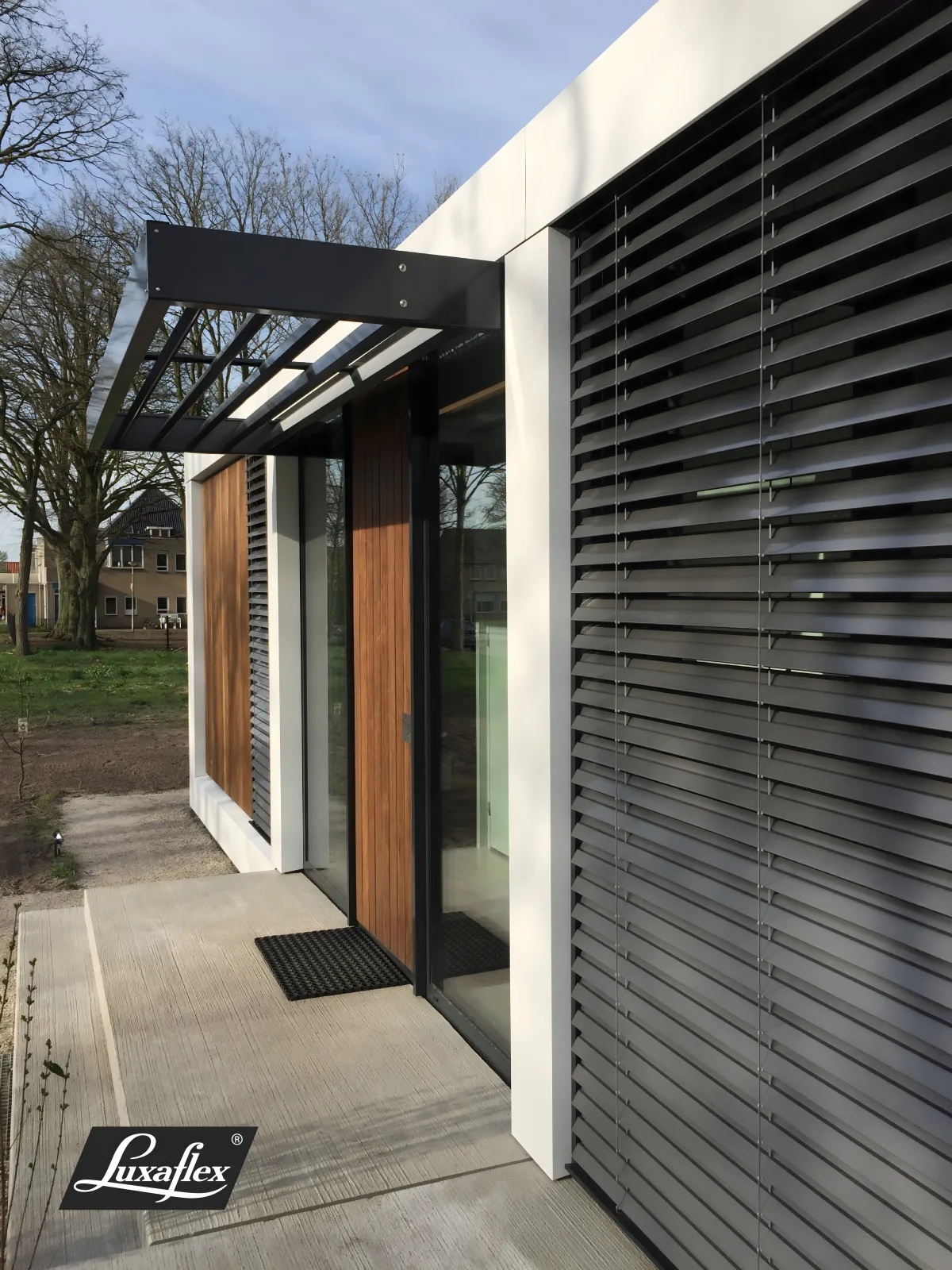
External Venetian blinds
from £750Adjustable aluminium slats on the outside of the window. Tilt them to cut the sun while keeping your view and daylight. The most flexible external option: full shade, filtered light, or fully open. Motorised as standard.
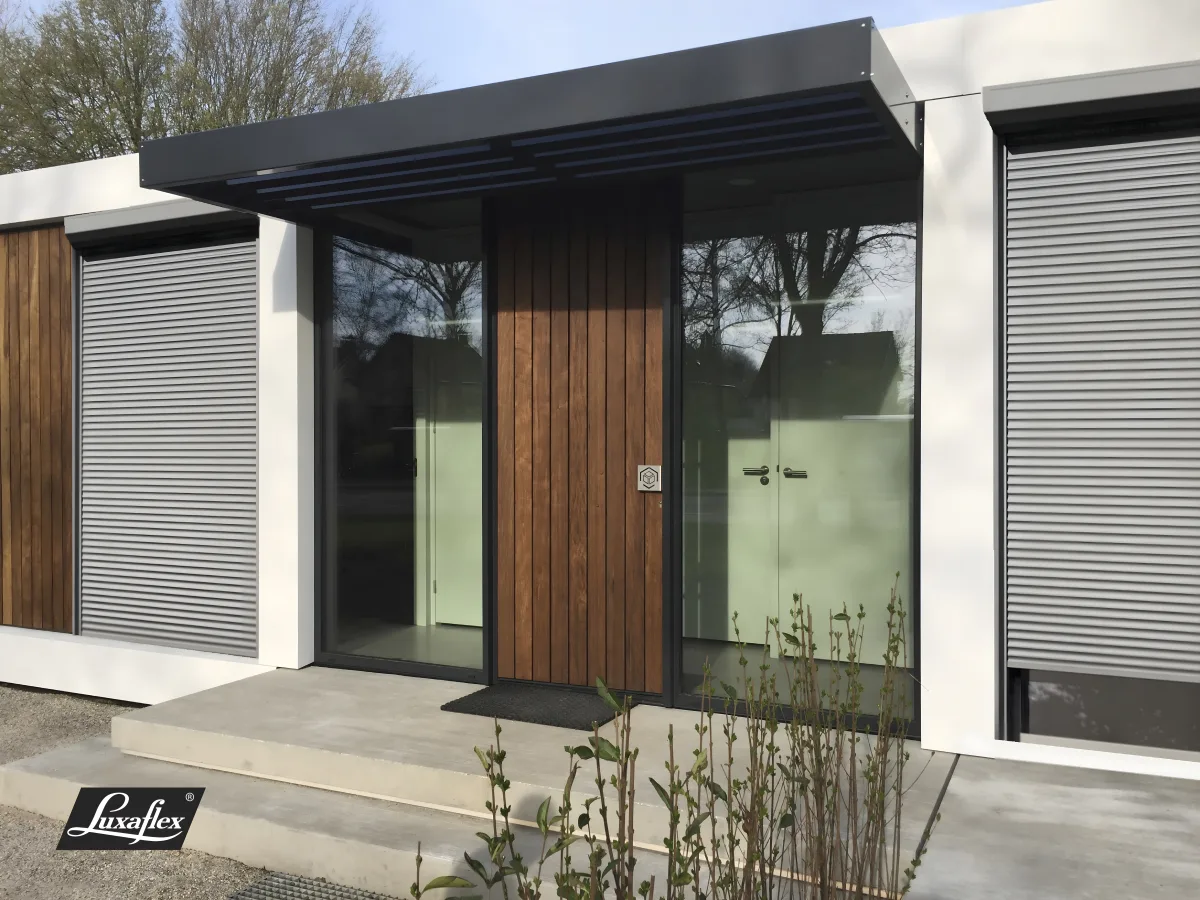
External roller shutters
from £1,100Aluminium slats that roll down into a box above the window. Excellent heat rejection, and they add a degree of security over uncovered glass, room-darkening and useful acoustic and winter-insulation benefits. They are not certified security shutters. When up, the slats retract into a slim box above the window. Motorised.
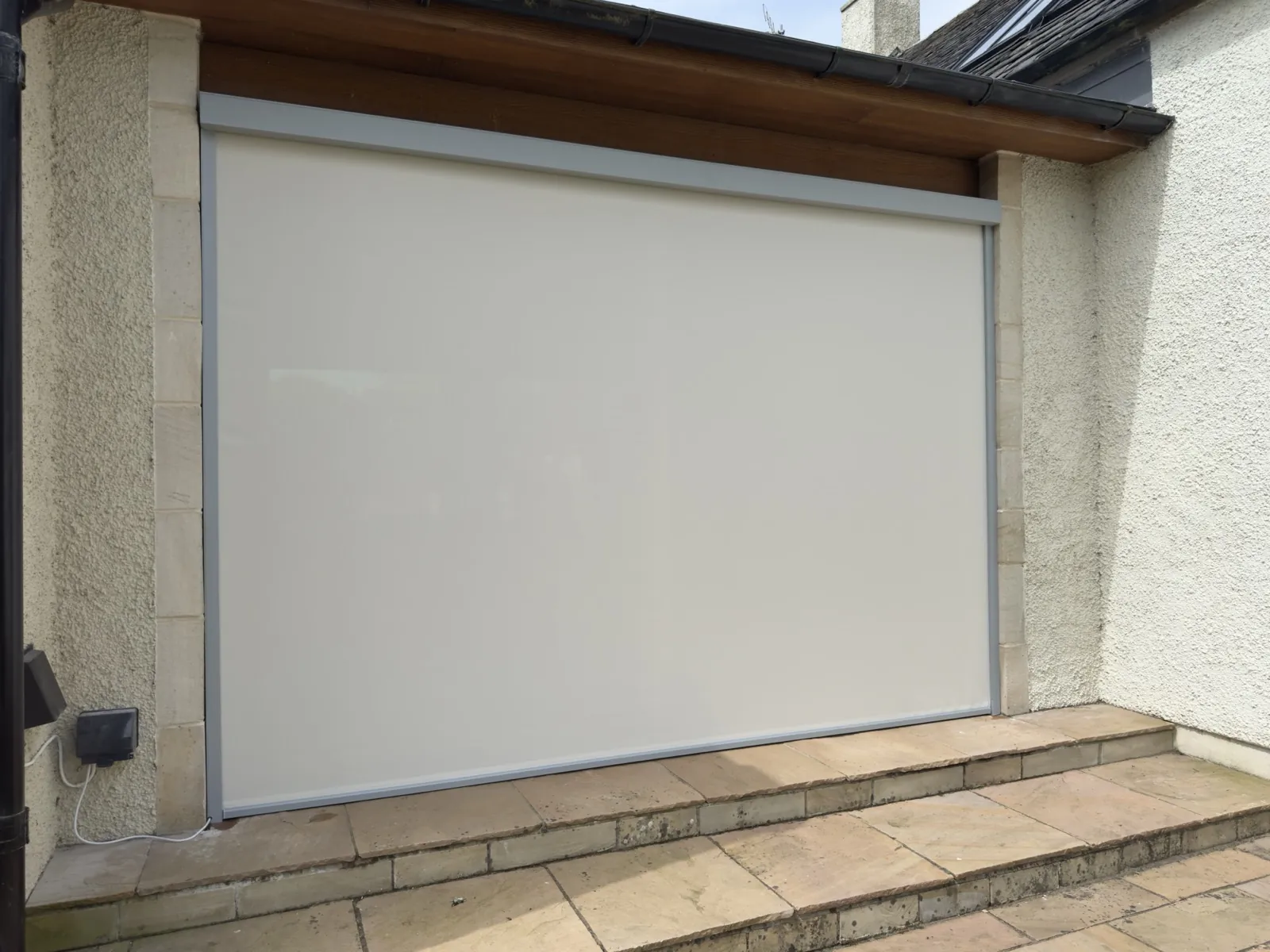
External zip screens
from £1,200A tensioned mesh fabric that runs in side channels, holding firm in wind. It cuts glare and heat sharply while you can still see out through the weave. A clean, modern look. Motorised.
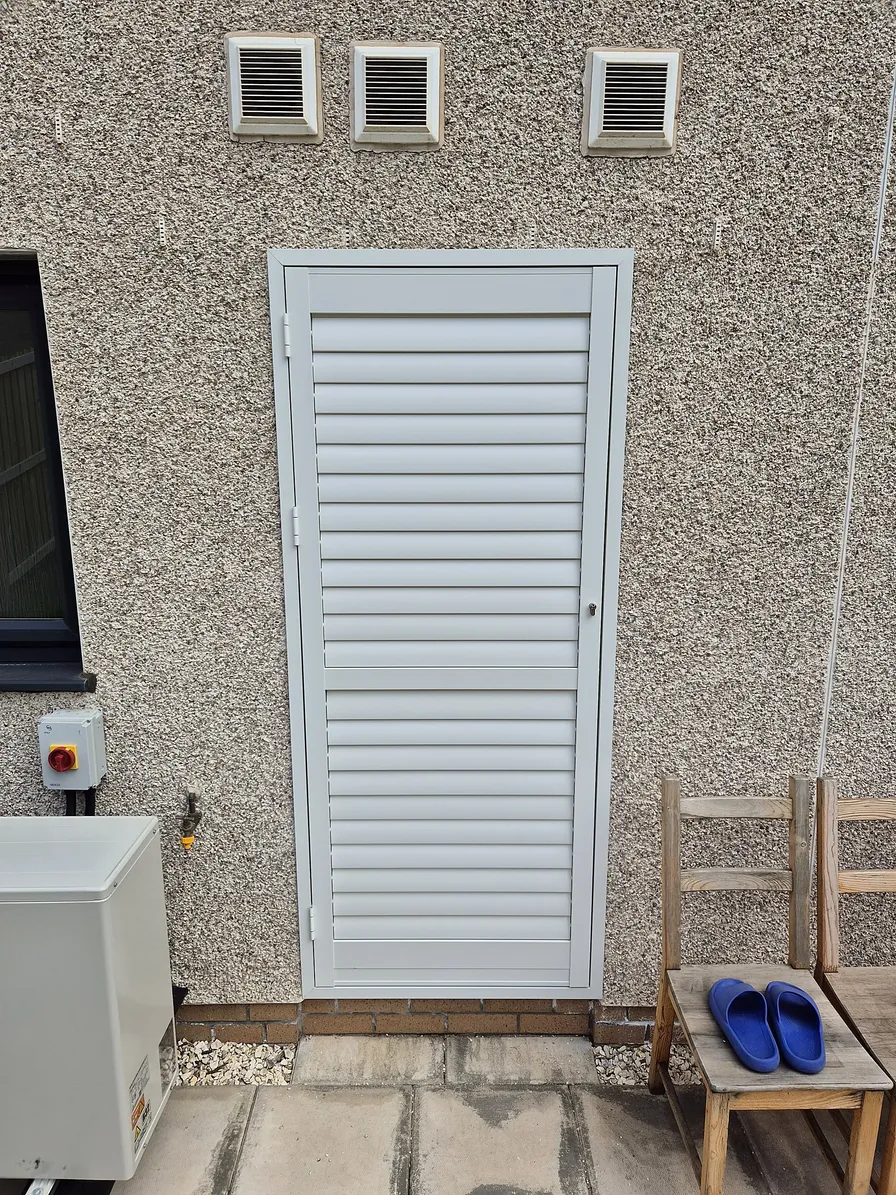
External aluminium shutters
from £1,450A very effective external shading device: hinged or bi-folding aluminium panels mounted outside the window, solid, durable, and a strong architectural feature. Manually operated.
Internal, fitted inside the room
Internal options have real advantages of their own. They cost less, they rarely need planning permission, they need no external wiring, and they are permanent, working every day of the year for privacy and light control, not just on hot afternoons.
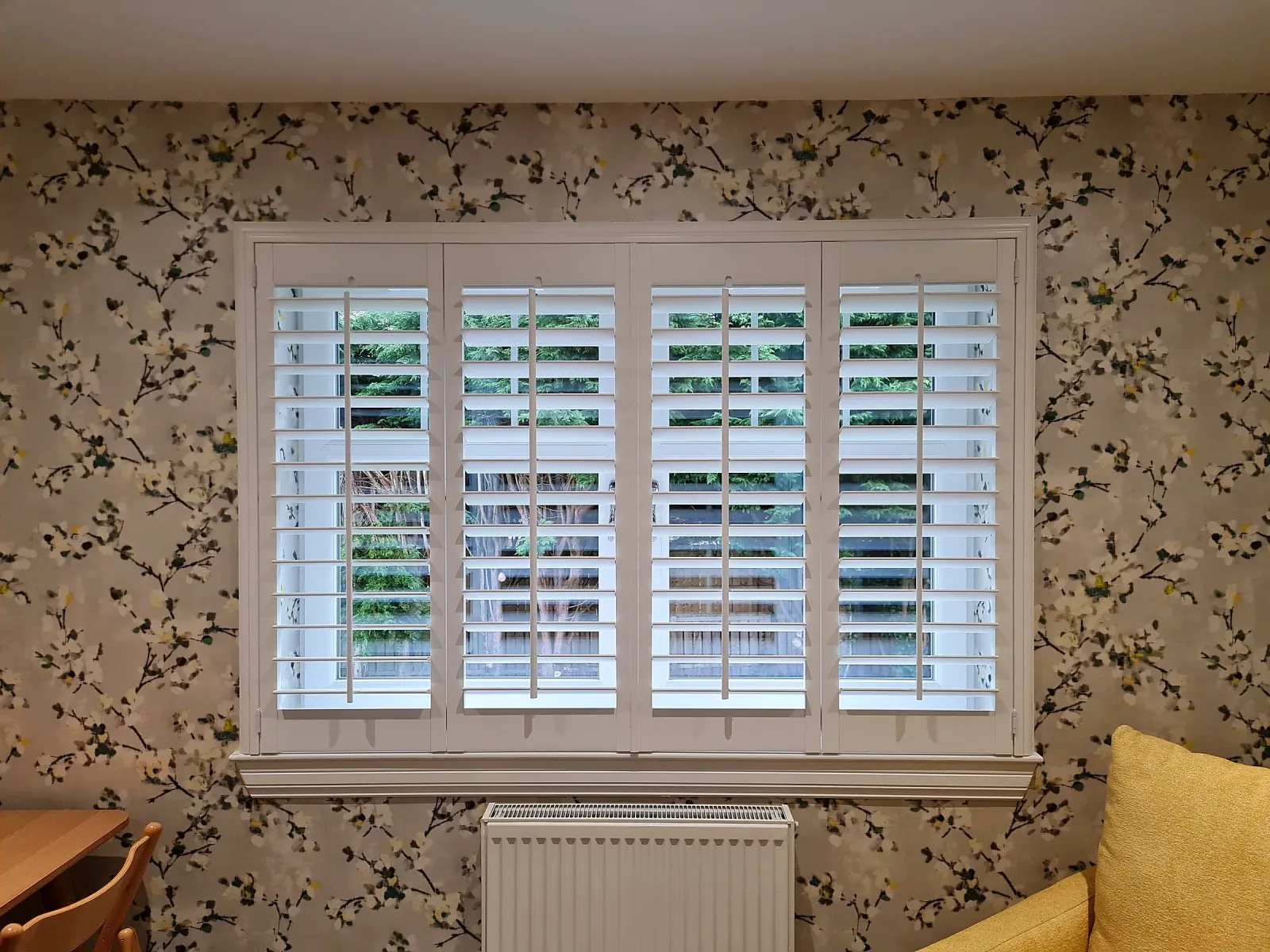
Interior wooden shutters
from £550Our core product. Permanent, elegant, and always in the window whether open or closed. They give you privacy, light control and a little insulation, and never need charging or a motor. As summer heat-rejection alone they do less than external shading, but they earn their place all year round. Manually operated.
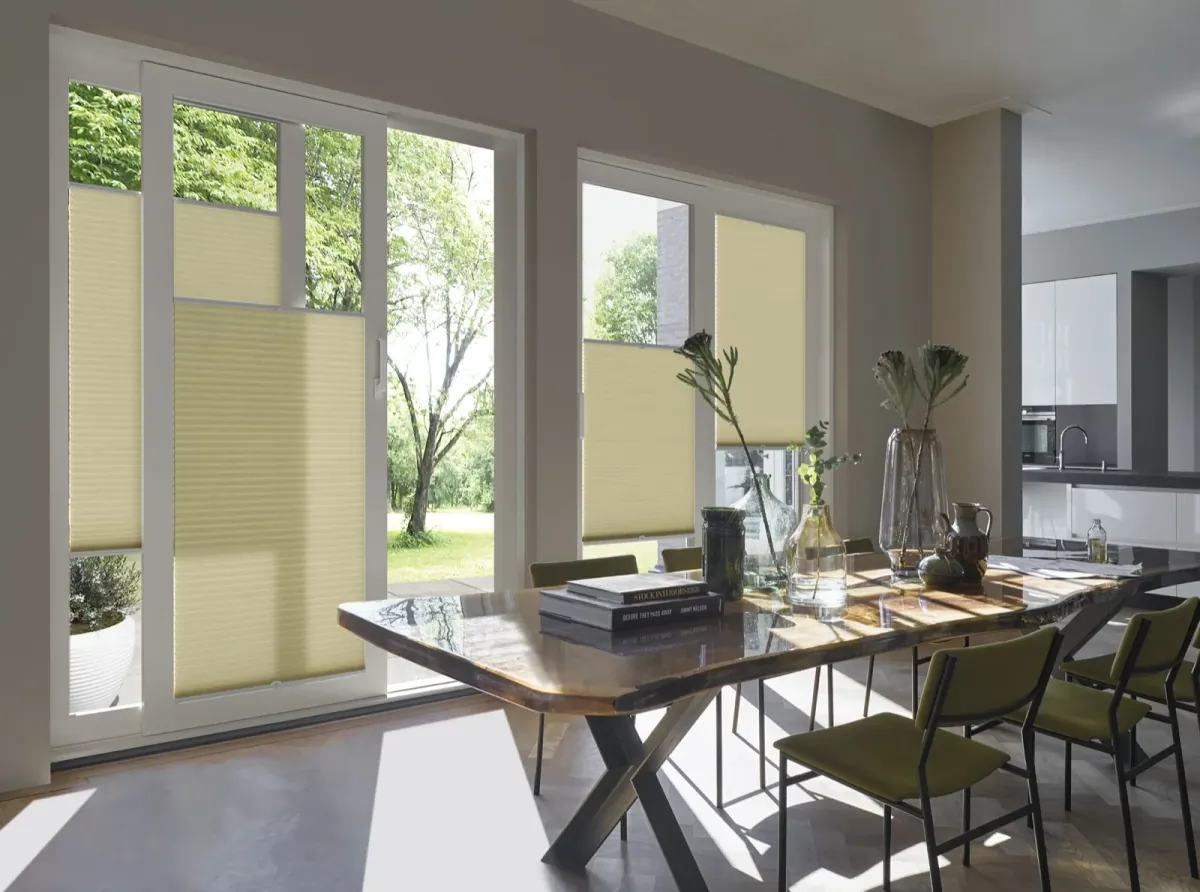
Duette cellular (honeycomb) blinds
from £650, motorisedA pleated fabric with an insulating air pocket built into its honeycomb cells. The best-insulating internal blind, useful against both summer heat and winter cold, available in translucent or room-darkening fabrics. Motorised here for a like-for-like comparison; most are sold with a simple cordless pull, which costs less.
Guide prices at a glance
Typical 1200mm by 1400mm window. Indicative, inc VAT, including our full service (survey, supply, fitting and guarantee). External electrical work is additional. Confirmed on survey.
| Shading | Fitted where | From |
|---|---|---|
| Interior wooden shutters | Inside | £550 |
| Duette cellular blind (motorised) | Inside | £650 |
| External Venetian blinds | Outside | £750 |
| External roller shutters | Outside | £1,100 |
| External zip screens | Outside | £1,200 |
| External aluminium shutters | Outside | £1,450 |
What moves the price
Every window is different, so treat the figures above as starting points. Price is affected by:
- Size. Bigger openings use more fabric, slats or panels.
- Fabric, colour and finish. Special colours and premium fabrics cost more.
- Motorisation and controls. External systems are motorised. The "from" prices are for the motorised product; a handset to operate it is required and is additional (a single handset can drive several blinds), and hubs or app control are extra again.
- Electrical work. External motorised products need a mains supply. Electrical work must be carried out by a qualified electrician, and is separate from the shading itself.
- Access and installation. Upper floors, awkward access and structural fixings all vary the labour.
So which should you choose?
If overheating is your main problem, especially on a south or west-facing room, external shading is the clear recommendation. External Venetians are the most flexible place to start, though our external shutters reject heat just as effectively. If your window faces north, or sits in shade for much of the day, you may not need external shading at all, and an internal blind or an interior shutter will serve you perfectly well for far less.
There is no single right answer, only the right answer for your window, your room and your budget. That is exactly what a home survey is for.
Common questions
Do I need planning permission for external shading?
Internal blinds and shutters almost never need planning permission, because they do not change how the building looks from outside. External shading is different: because it alters your home’s external appearance it can need planning permission, and it is more likely to if you live in a conservation area. Always check with your local council before ordering. (Source: mygov.scot.)
What about listed buildings and conservation areas?
If your home is listed you will usually need listed building consent for anything fixed to the outside, and in a conservation area normal permitted-development rights are restricted. Speak to your local authority, and for listed buildings, Historic Environment Scotland, early on.
What are the running costs of motorised shading?
Very low. A motor draws power only for the few seconds it moves, and modern systems use very little on standby. Battery-powered options need an occasional recharge rather than any wiring.
How long do they last, and what maintenance is involved?
External aluminium systems are built for outdoor life and weather. Internal shutters and blinds are long-lived indoor products. All benefit from an occasional wipe or dust; motors and moving parts can be serviced or replaced if ever needed.
Will external shading cause condensation?
No. Stopping heat outside the glass has no bearing on internal humidity. Condensation is a ventilation issue, not a shading one.
Can I fit them myself?
Internal shutters and blinds can be supplied for self-fit if you are confident measuring and drilling. External motorised systems really need professional installation and a qualified electrician, so we do not recommend fitting those yourself.
Sources and method
- Reference window and price basis: a single 1200mm by 1400mm window, inc VAT. The external blind, screen and roller-shutter "from" prices are taken from Luxaflex retail price lists (2024 to 2025). The interior wooden shutter and external aluminium shutter "from" prices are our own installed retail. "From" prices are starting points for that size, rounded for survey headroom; your quotation is confirmed on survey. Reviewed July 2026.
- Solar heat rejection (g-value): British Blind and Shutter Association (BBSA), bbsa.org.uk/householders/overheating.
- Cooling energy saved: National Energy Foundation building modelling using EnergyPlus, as reported by the BBSA, bbsa.org.uk.
- The Shard example: CIBSE Journal CPD Module 125, "Applying solar shading to reduce overheating in buildings" (2018), cibsejournal.com.
- The national picture on overheating: House of Commons Library, Is the UK prepared for heatwaves?, research briefing CBP-10956, 14 August 2026, commonslibrary.parliament.uk. Contains Parliamentary information licensed under the Open Parliament Licence v3.0.
- Planning, listed buildings and conservation areas: mygov.scot and Historic Environment Scotland, historicenvironment.scot. Always confirm with your own local authority.
The technical content on this page was reviewed by David D'Ambrosio, our Technical Director and a Past President of the British Blind and Shutter Association (BBSA).
Last reviewed: by David Browne, Project Director
Not sure which is right for your window?
Book a home survey and we will recommend the right shading for your room, your orientation and your budget, with a clear fixed quotation. No pressure, no sales pitch.