
When Shutters Bow to the Sun: What Those Warped Louvres Are Really Telling You
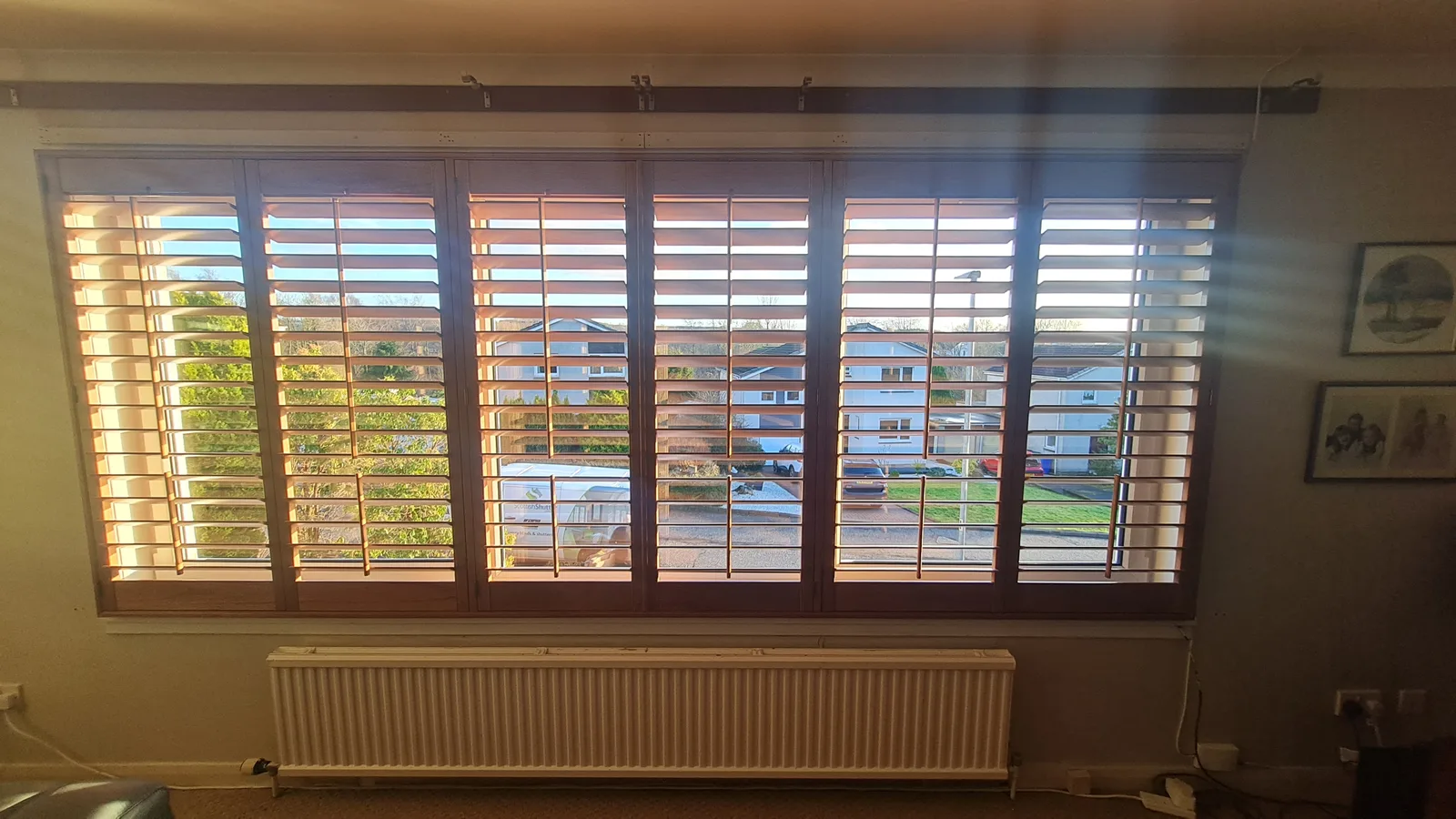
We came across some pictures the other day on a trade website, a customer’s south-facing window, fitted with what looked like a perfectly respectable set of interior shutters. White, neat, the right size for the opening. At a glance, you’d think they were doing their job nicely.
Then you looked again. Every single louvre across the panel was bowed in the middle, curving downward like a row of weary smiles. The top edges of the slats had pulled away from the frame. The whole thing had gone soft.
That’s not a manufacturing fault. That’s the sun doing exactly what the sun does to cheap vinyl shutters, and a story worth telling, because there’s a lot of confusion in our industry about what shutters are made of and where they belong.
All Plastic Shutters Are Not Created Equal
Here’s the thing most homeowners don’t realise: when someone says “faux wood shutters” or “plastic shutters,” that single phrase covers an enormous range of products, from the genuinely excellent to the embarrassingly poor. They look almost identical in the Design Studio. They look very different two summers later.
At the bottom of the market sits cheap vinyl, sometimes labelled PVC. This is the material in the photos we saw. It’s soft, it’s flexible, it’s inexpensive to extrude in long lengths, and it has a relatively low heat deflection point, meaning it starts to soften at temperatures a south-facing window achieves easily on a sunny day. Combine that with the fact that a louvre is unsupported in the middle (held only at each end by pivot pins) and you have a recipe for exactly the kind of sag you see in those pictures. Gravity wins, the slat bows, and once it’s cooled it never quite returns to straight.
At the top end of the plastic category sits ABS, acrylonitrile butadiene styrene. This is a completely different polymer. It’s the same family of plastic used for Lego bricks, motorcycle helmets, and the dashboards of cars that sit in summer car parks for years without deforming. It’s harder, more dimensionally stable, and has a significantly higher heat deflection temperature than vinyl. It’s also more expensive to manufacture, which is why you don’t find it at the bargain end of the market.
Between those two extremes sit various composites, polypropylene-wrapped MDF products, and unbranded “faux wood” offerings of variable quality. The trouble is that the shutter trade rarely makes the distinction clear to customers. “They’re plastic” gets used to mean everything from a £150 internet special to a properly engineered premium product, and the price tag is often the only clue you get.
Why the Photos Show What They Show
The shutters in those pictures are almost certainly cheap vinyl. There are a few giveaways: the depth of the bow across every louvre, the consistency of the deformation (suggesting bulk material failure rather than damage to one slat), and the fact that the panels were fitted to a south-facing window in the first place, which any experienced installer would have steered the customer away from with that grade of product.
It’s a reminder that our trade still has its share of inexperience. The shutters get sold on price, the order goes in, the installation looks great on the day, and the problem only shows up when the customer has long since paid the invoice. By the time the louvres start sagging, the original fitter is unreachable and the customer is left holding a very expensive lesson.
That’s not a great look for any of us. Shutters as a category deserve better, and so do the homeowners buying them.
Where Our ABS Ranges Fit In
At The Scottish Shutter Company we work with two ABS-based ranges, and they sit in a completely different category from the products in those photos.
S:Craft’s Java range is crafted from high-grade ABS and is engineered specifically as a robust alternative to cheap vinyl. The manufacturer describes it as “100% water resistant” and “fully moisture resistant,” and recommends it for bathrooms, kitchens, and rooms with condensation, though even here, there are important distinctions between premium ABS and cheap vinyl that get marketed as “waterproof,” a topic we cover in detail in our article on waterproof shutter claims. We’ve been fitting Java for years across Edinburgh, Dundee, and the rest of central Scotland, and across that installation history we have zero callbacks for heat warping on this range.
Custom West’s Hollywood range, supplied through Luxaflex, is also ABS. The manufacturer describes it as having “superior strength to prevent warping, denting and chipping,” a direct quote from Custom West’s own materials. It’s available in 18 colours plus a custom colour finish option, and shares the same fundamental advantages: dimensional stability, moisture resistance, and a finish that’s genuinely difficult to distinguish from painted timber.
Are these ranges suitable for south-facing windows? In the vast majority of cases, particularly standard-sized panels, yes, they perform very well. We wouldn’t have been fitting them for as long as we have if they didn’t. But they’re not the answer to every situation, which brings us to the next point.
When Real Wood Is Still the Right Answer
There are circumstances where we’ll always steer a customer towards a real hardwood shutter rather than ABS, and they tend to involve one or more of the following:
- Very wide panels on a south-facing window. Any louvre, in any material, is more susceptible to sag the wider it gets. For larger panels in full sun, hardwood’s stiffness simply outperforms plastic.
- Very tall louvres in continuous direct sun. Same principle.
- Period properties and listed buildings. Hardwood is what these windows were designed for, and it’s often what listed building consent requires.
- Customers who want the shutters to be a fifty-year investment. Well-made hardwood shutters, properly finished, will outlast most of the rest of the house.
- Bespoke shapes, arches, gables, circles. Real wood is more forgiving to craft into unusual geometries.
Our premium hardwood range, S:Craft’s Fiji, uses kiln-dried timbers. The stained version is made from paulownia, a fast-growing sustainable hardwood with a high strength-to-weight ratio. The painted version is constructed from a combination of premium hardwoods including basswood and ayous. Both versions handle direct Scottish sunlight without complaint, year after year.
The Practical Rule of Thumb
If you take nothing else from this, take this:
- For bathrooms, kitchens, wetrooms, and most north/east/west-facing windows, a quality ABS range like Java or Hollywood is an excellent, sensible, and durable choice.
- For very large south-facing windows, listed buildings, and “lifetime investment” projects, go hardwood.
- For the cheapest plastic shutters you can find online, don’t. Whatever you save now, you’ll spend later, and you’ll spend it twice.
The biggest mistake homeowners make isn’t choosing plastic over wood. It’s not asking what kind of plastic. There’s a world of difference between high-grade ABS and the soft vinyl in those Facebook photos, and a reputable supplier will be perfectly happy to tell you exactly which one they’re proposing to fit.
Continue Reading: The Cheap-Shutter Problem Goes Deeper
This is one of four articles investigating the most common problems we see with budget shutters across Scotland. The other three tackle related but separate issues:
→ The Hidden Risks of Perfect Fit® Shutters, why the no-drill clip-fit system can put your double-glazing warranty into dispute.
→ When “Waterproof” Shutters Aren’t Waterproof, why a “waterproof” material doesn’t necessarily make a waterproof shutter, and what happens inside hollow vinyl panels in a humid bathroom.
→ The Chemistry No One Wants to Talk About, what heated PVC shutters may be releasing into your home.
Or read the full guide at Plastic Shutters: What You Actually Need to Know.
Why Choose The Scottish Shutter Company
We’ve been fitting shutters across Scotland for almost forty years, and one of the most important parts of our consultation process is matching the right material to the right window. South-facing wall of glass? We’ll talk you through hardwood. Compact bathroom window? Java will do the job beautifully for a fraction of the cost. Listed Georgian townhouse? Hardwood, every time, and we’ll handle the consent paperwork.
We’re full members of the British Blind and Shutter Association (BBSA). Our Technical Director, David D’Ambrosio, is the BBSA’s go-to expert on shutters and a Past President of the Association. We work directly with premium manufacturers (S:Craft, Luxaflex, Custom West), and every installation is carried out by our own team, not subcontracted out to whoever’s available this week. If anything ever does go wrong, you know exactly who to call.
Ready to Get It Right First Time?
If you’re thinking about shutters for any room in your home, and especially if you’ve been quoted by someone who couldn’t tell you what their “faux wood” is actually made of, we’d love to help you make a properly informed decision.
Contact us today for a free in-home consultation or download our brochure for a closer look at our full range, from waterproof ABS to premium hardwoods.
Get it right once, and you won’t need to think about it again.
Inspired by what you've read?
Request a brochure or arrange a no obligation consultation.