
Blinds and Shutters for Tilt and Turn Windows
Blinds and Shutters for Tilt and Turn Windows
If you’ve moved into a new build in Scotland, there’s a good chance you have tilt and turn windows. They’re excellent windows, and we get a lot of enquiries from people who’d like blinds or shutters for them. They do need a different approach, though, because the way they open rules out the blinds and shutters that suit most other windows.
This guide explains what a tilt and turn window is, why your architect chose it, why it causes trouble for blinds and shutters, and what we fit instead.
Is your window a tilt and turn, or a reversible?
People call these windows all sorts of things. We hear “the window that opens two ways”, “the one that tips in at the top”, “European windows” and “inward opening windows”. They usually mean the same thing.
A tilt and turn window has one handle with three positions:
- Handle down: closed and locked.
- Handle sideways: the top of the window tips into the room for ventilation.
- Handle up: the window swings into the room like a door.
Some windows are set up the other way round, so try yours gently before you rely on it.
The easy test is to open it and look. Does any part of the window come into the room, past the frame? If it does, you have a tilt and turn.
Many Scottish homes also have fully reversible windows, and these get mixed up with tilt and turn all the time. A reversible window turns over within its own frame, almost all the way round, so you can clean the outside glass from inside. The sash never comes into the room past the frame. That makes all the difference, as you’ll see below.
Why so many new builds have them
There’s no rule that says a house must have tilt and turn windows. What the building standards set are things a window has to achieve, and a tilt and turn window achieves several of them at once.
- Cleaning from inside. The Scottish building standards expect windows more than 4m above the ground to be cleanable safely, and cleaning from inside is one accepted way. Because the window swings fully into the room, you can reach the outside glass without leaning out.
- Airtightness. When it’s closed, the locks pull the window tight against a seal all the way round. That’s why tilt and turn windows are a favourite on low-energy homes.
- Fresh air without an open window. In the tilt position, air comes in while the window stays locked and hard to get through. That’s useful in a bedroom at night.
- A way out. Turned fully open, the window gives a large clear opening, so it can also serve as an escape window.
- Where the windows come from. Many high-performance timber and aluminium-clad windows are made in Scandinavia and Germany, where tilt and turn is the standard window.
So your architect hasn’t made a strange choice. They’ve picked the window that ticks the most boxes.
Why tilt and turn windows are a problem for blinds and shutters
On most windows we fit blinds and shutters inside the window recess. It’s the neatest finish, and it’s how most people picture a blind or shutter.
That works because most windows stay out of the recess when they open:
- Outward opening casement and top-hung windows swing outside.
- Sash windows slide up and down.
- Reversible windows turn over within their own frame.
A tilt and turn window does the opposite. It tilts into the recess at the top and swings into the room through the recess when it turns. A blind fitted at the top of the recess sits exactly where the window wants to go. A shutter fitted inside the recess stops the window opening at all. The handle often catches as well.
That’s why one window type causes so many problems.
What works on tilt and turn windows
The answer is to fit something that moves with the window, or something that sits outside the space the window needs.
TruFit blinds
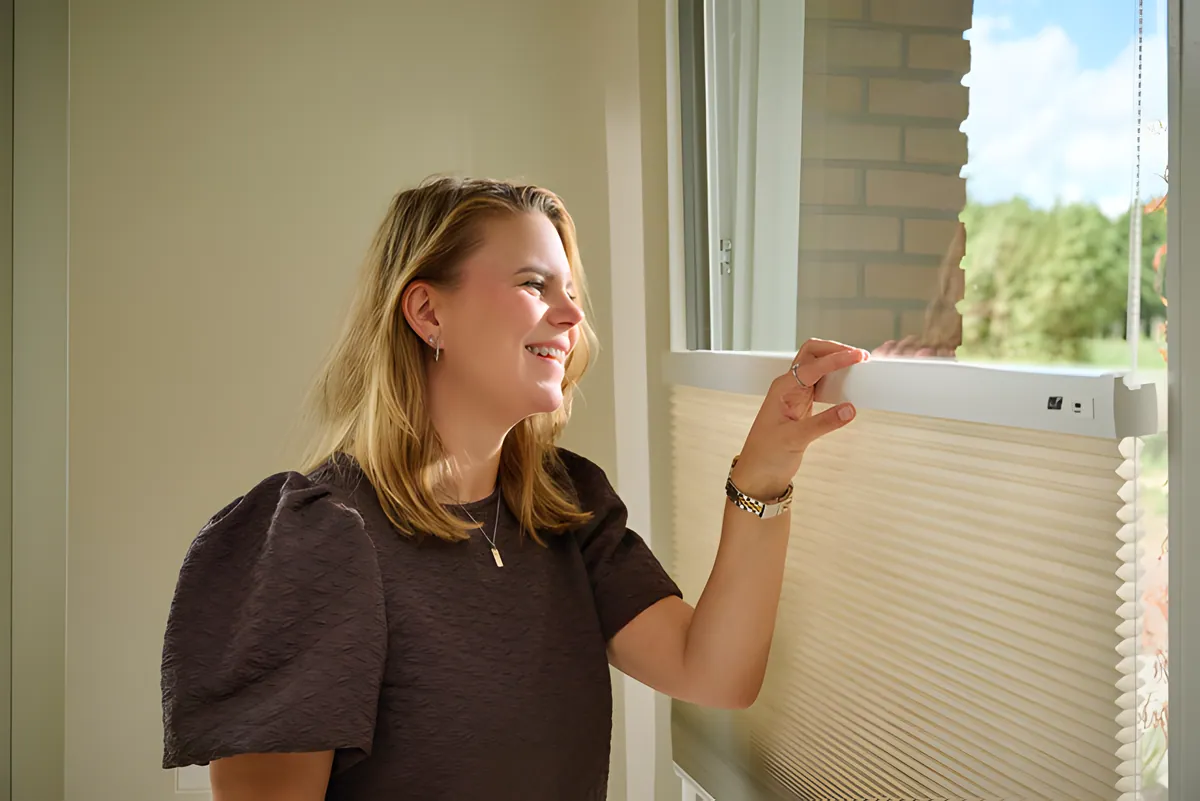
TruFit bonds to the glass itself, in narrow side channels, so the blind moves with the window when you tilt or turn it. There are no rails at the top or bottom, so it can be raised from the bottom or lowered from the top. Nothing is drilled into the frame. We’ve written more about it in TruFit blinds for tilt and turn windows.

Luxaflex DuoMotion
DuoMotion was designed for tilt and turn windows. The top rail is motorised and can be worked from an app, a remote or by hand, and the bottom rail moves by hand. Cords at each side keep the fabric close to the glass even when the window is tilted or open.
Shutters on a Camber Deco frame
You can still have shutters on a tilt and turn window. Instead of fitting the frame inside the recess, we use a Camber Deco frame, which fits on the face of the wall around the outside of the recess. That leaves the recess clear, so the window can still tilt and turn behind the shutter. A Camber Deco frame makes the shutter a little larger than one fitted inside the recess. Our guide to shutter frames explains the differences.
What to check before you buy
- How each window opens. Check every window, not just one. Many houses mix tilt and turn with reversible or outward opening windows, and each type takes a different product.
- Where the handle sits. It affects where a blind can start and stop.
- Your window maker’s terms. Some window makers’ warranties mention shading fitted close to the glass, usually in connection with heat stress in the glass. It’s worth reading your own window paperwork, and we’re happy to go through it with you.
In short
- Tilt and turn windows swing into the room, so they use the space where a blind or shutter would normally go.
- Reversible windows don’t come into the room, so we can fit inside the recess as usual.
- TruFit and DuoMotion move with the window or work around it.
- Shutters on a Camber Deco frame sit outside the recess and leave the window free.
- Check how every window opens before choosing a product.
If you’re not sure what you have, send us a photo of the window open. You can request a brochure or arrange an appointment, and we’ll tell you what will work on each window.
Frequently asked questions
What is a tilt and turn window? A tilt and turn window has one handle that either tips the top of the window into the room for ventilation or swings the whole window into the room like a door. It’s common on new build homes in Scotland.
Can you fit blinds to tilt and turn windows? Yes. Blinds that bond to the glass, such as TruFit, move with the window, and DuoMotion was designed for tilt and turn windows. A standard blind fitted at the top of the recess usually gets in the way of the window.
Can you fit shutters to tilt and turn windows? Yes, on a Camber Deco frame fitted on the face of the wall around the outside of the recess. That keeps the recess clear, so the window can still tilt and turn behind the shutter.
What is the difference between a tilt and turn window and a reversible window? A tilt and turn window opens into the room. A fully reversible window turns over within its own frame so you can clean the outside glass, and it never comes into the room. Blinds and shutters can usually be fitted inside the recess of a reversible window as normal.
Why do new build houses have tilt and turn windows? They meet several building standard requirements at once. You can clean them from inside, they seal tightly when closed, they ventilate securely when tilted, and they open wide enough to serve as an escape window.
Inspired by what you've read?
Request a brochure or arrange a no obligation consultation.