

Why we use AI, and why a person has the final say
You can hardly open a newspaper at the moment without reading about AI. Some stories say it will cure diseases. Others warn it could wipe out civilisation within a decade.
It’s enough to make anyone a little uneasy, and you might reasonably wonder whether contacting a family shutter company now means talking to a machine. It doesn’t. You’ll talk to real people, and one of our specialists approves every quotation before you see it.
We’ve been using AI at The Scottish Shutter Company for some time now. This year our work with it made us finalists three times over: Best Innovation at the National Entrepreneur Awards, and both Digital Innovation categories at the Dundee and Angus Chamber Champion Awards.
So it seems only fair to tell you how we use it, what it does for you, and just as importantly, where we draw the line.
Real people, not robots
Let’s start with the part that matters most. Nobody here is a robot, and nobody here is a salesperson either. We’re a team of seven specialists, and we’ve never employed anyone to sell.
When you talk to us, you’re talking to someone who knows the product. For almost every customer, the survey is carried out in person, in your home, by one of our own team, and your shutters or blinds are fitted by our own fitters. And every quotation you receive has been read and approved by one of our specialists before it’s sent.
AI works behind the scenes, on the parts of the job where accuracy matters and mistakes are easy to make. The judgement, the advice and the care are still ours.
Should we be worried about AI?
A friend and mentor of ours puts it simply. AI is just a tool. It’s like fire: you can toast marshmallows with it, or you can burn your house down.
History is full of tools like that. In the 1860s, when steam vehicles took to Britain’s roads, the law required a man to walk ahead of them carrying a red flag to warn people. Their successor, the motor car, went on to change everyone’s lives for the better, yet it still costs well over a thousand lives a year on Britain’s roads, usually when it’s used carelessly. We didn’t ban it. We brought in driving tests, speed limits and seatbelts, and we hold drivers responsible.
Nuclear science is the same. It powers the scans and cancer treatments that save lives every day, and it also built the atomic bomb. As the French philosopher Paul Virilio put it, “When you invent the ship, you also invent the shipwreck.”
A tool is only as good, or as dangerous, as the people using it and the rules around it. So here are our rules, and what they mean for you.
A person always has the final say
Some AI systems can make decisions without a person approving every step, and some of the systems we’ve built work that way too. That’s a real difference from fire or a car, and we take it seriously.
Our rule is simple. AI can do the legwork, but a person has the final say on anything prepared for you. Nothing AI produces for a particular customer, whether a quotation or advice about your windows, reaches you until one of our team has checked it. Our online calculator gives a guide price only, and a person confirms any firm price. Our routine emails, like brochure deliveries, go out automatically, but from wording one of us wrote and approved.
Think of it as a driving test for everything the AI writes.
Accurate pricing for complicated windows
Complex shading means complex pricing.
A shaped gable window, an apex, an angled rooflight or a roof lantern isn’t priced from a single list. It’s priced from hundreds of separate manufacturer tables, across different ranges, fabrics and sizes. Every product also has its limits: a smallest and largest width, a longest drop, a steepest angle it can follow. Miss one of those and the blind can’t be made, or the price you were given won’t hold.
Our own pricing tools check every window against those limits and look up every figure from the manufacturer’s own price list. A specialist then checks the result. It means surprises after you’ve ordered are rare, and if something can’t be made, we aim to tell you before you commit, not after.
Every claim, checked
The rules on what a business can claim, especially about energy and the environment, are strict, and rightly so. The Competition and Markets Authority’s Green Claims Code and the British Blind and Shutter Association’s own guidance say the same thing: start with the evidence, and only claim what it supports.
We applied that standard to our own website first. Using AI, we checked it line by line and found claims we couldn’t back up with evidence, some of them about energy. We’ve now replaced every heat-loss figure we couldn’t back up with figures from named sources, mainly our trade body’s independent testing, and we’re still working through the more general wording in our older articles.
That’s also why you won’t find a promise in this article about how much you’ll save on your heating bill. That depends on your house, your tariff and the weather, and no single figure fits everyone.
Technical shading, done properly
Shading a room well is a technical job, and it’s getting more technical. Since February 2023, new homes in Scotland have had to be assessed for the risk of overheating, and more glass in modern homes means more rooms that get too hot in summer.
Our Technical Director, David D’Ambrosio, is a Past President of the British Blind and Shutter Association, and we remain closely involved in its work, including its work on Scotland’s building standards.
Keeping on top of the standards, the guidance and the published test evidence used to be beyond a team our size. AI lets us read and cross-check it properly, so the advice you get from us rests on the evidence rather than on habit.
More done in a day, not a shorter day
AI hasn’t made our working days shorter. It means each of us gets through far more in a day.
That matters. In the 30 days to late September 2026, more than 300 new enquiries and brochure requests reached us, and we have seven specialists. In our experience, a complicated shaped window that could take up to four hours to price now takes twenty to thirty minutes, and the time that frees up goes straight into the next customer’s window.
It also saves a journey. Anywhere in Scotland or the far north of England, we can give you an indication of cost from a few photographs and rough sizes of your window. Our AI can read photographs, drawings and rough measurements, and one of our specialists checks the result, so nobody has to drive out just to tell you roughly what something will cost.
For you, that means an answer in days rather than weeks, from a specialist who has had time to think about your window properly.
What about our carbon footprint?
AI runs in enormous data centres that use a great deal of electricity, so what does our use of it cost the planet? It’s a fair question.
Here’s what we know. We measure how much work our system does, and between late June and early August this summer it processed at least 12.7 billion tokens, the small chunks of text that AI reads and writes. That’s a lot. The AI company we use doesn’t yet publish its emissions, so we can’t turn that into a carbon figure, and we won’t guess one.
But that’s only one side of the ledger. The other side is what we actually do for a living, because the right shading can cut the energy a building uses for heating and cooling.
Both our directors, David Browne and David D’Ambrosio, are certified solar shading advisers, certified by ES-SO, the European Solar Shading Organisation. Advising on how homes and buildings can use less energy through shading is exactly what that certification is for.
Research funded by ES-SO modelled what would happen if three-quarters of Europe’s windows had dynamic shading, meaning shading that’s adjusted to suit the conditions, and estimated a saving of between 117 and 137.5 million tonnes of CO2 a year. That’s a modelled scenario, not a measurement, and those figures aren’t for any one product, including ours.
In Scotland, the bigger prize is usually keeping the heat in. Government figures put around 18% of a home’s heat loss through its windows. In independent testing commissioned by the British Blind and Shutter Association at the University of Salford’s Energy House, a closed shutter cut heat loss through the glass by around 30%, and a honeycomb blind with a foil insert, fitted to the glass, by 34%, on the glazing tested.
In summer, shading is an alternative to air conditioning. The International Energy Agency estimated in 2018 that the world’s air conditioners would grow from 1.6 billion to 5.6 billion by 2050. Shading fitted outside the glass stops much of the sun’s heat before it gets in, and a blind inside cuts how much reaches the room. Neither needs the power an air conditioner does to pump that heat back out. And Scotland’s building standards now name external shutters and louvres as one way to keep a new home from overheating, which is work we do too.
So does the energy our work saves outweigh the electricity our AI uses? That’s the question we want to answer properly, and we can’t yet. We haven’t measured both sides for our own business, so we’re not making the claim. We’ve started building that measurement, and we’ll publish the figure when we have one we can stand behind.
What AI will never do here
AI can’t feel the quality of a hardwood louvre, or picture how the morning light falls across your bay window.
It won’t measure your windows. It won’t sit with you in one of our Design Studios choosing colours and finishes. And it certainly won’t fit your shutters. That’s the job of our own experienced team, and it always will be.
What about jobs?
When the car replaced the horse, the people who bred horses, ran coaching inns and swept the streets saw their work disappear. But the car also created mechanics, garages, road builders and driving instructors, whole new kinds of work.
Nobody at The Scottish Shutter Company has lost their job to AI. When a colleague left for another role this year, we found the system was already doing much of that work, so the post wasn’t refilled. For the rest of us, it has taken away repetitive work so we can do more of what we’re good at. That’s how we think technology should work in a business: helping people, not replacing them.
Our horsepower, our craft
For a family business founded in 1987, AI isn’t a threat to our craft. It’s our horsepower: it pulls, we steer. The expertise, the care and the quality are still ours.
We’re Scotland’s only Luxaflex Gallery Dealer, and we take both our craft and our responsibilities seriously. If you’d like to read more about the pricing side and the team behind it, see Seven specialists, no salespeople, and an innovation award final.
The short version
- AI is a tool. Like fire or the motor car, what matters is who uses it and the rules around it.
- Our own team surveys and fits almost every job, and a person approves every quotation.
- AI makes our pricing more accurate and lets a team of seven answer far more enquiries.
- We only claim what we can evidence, including about our own carbon footprint.
- Nobody here has lost their job to AI.
See the difference for yourself
If you’d like to talk about your windows with one of our team, you can arrange an appointment or request a brochure whenever it suits. You can also browse finished work in our gallery.
Frequently asked questions
Does The Scottish Shutter Company use AI? Yes. We use AI to help price complicated windows, check technical and product information, and handle repetitive admin. A person checks anything prepared for an individual customer before it reaches them.
Will AI measure or fit my shutters? No. AI plays no part in either. For almost every customer, the survey is carried out in person by one of our own team, and the installation by our own fitters.
Is my quotation written by AI? Our pricing tools do the calculations and check each window against the manufacturer’s size limits, particularly for shaped and angled windows. One of our specialists reads and approves every quotation before it’s sent to you.
Can you give me a price from photographs? Yes, as a first step. Anywhere in Scotland or the far north of England, send us a few photographs and rough sizes of your window and we can give you an indication of cost. Our AI reads the photographs, drawings and measurements, one of our specialists checks the result, and a firm price follows once your windows are measured properly.
Has AI replaced any staff at The Scottish Shutter Company? No. Nobody has lost their job to it. When a colleague left this year, the system was already covering much of that work, so we didn’t refill the post.
Doesn’t AI have a large carbon footprint? AI uses a lot of electricity, and the AI company we use doesn’t yet publish its emissions, so we can’t put a figure on our share. The work we do sits on the other side of the ledger: in independent testing, a closed shutter cut heat loss through the glass by around 30%, on the glazing tested, and research funded by the European Solar Shading Organisation modelled large carbon savings if most of Europe’s windows had shading that’s adjusted to suit the conditions. Those figures aren’t for any one product, and we won’t claim a net figure for our own business until we’ve measured it.
Is AI dangerous? It can be, like any powerful tool. Serious experts disagree about how controllable future AI will be, which is why we think the people using it and the rules around it matter most. At The Scottish Shutter Company, a person has the final say on everything prepared specifically for you.
Inspired by what you've read?
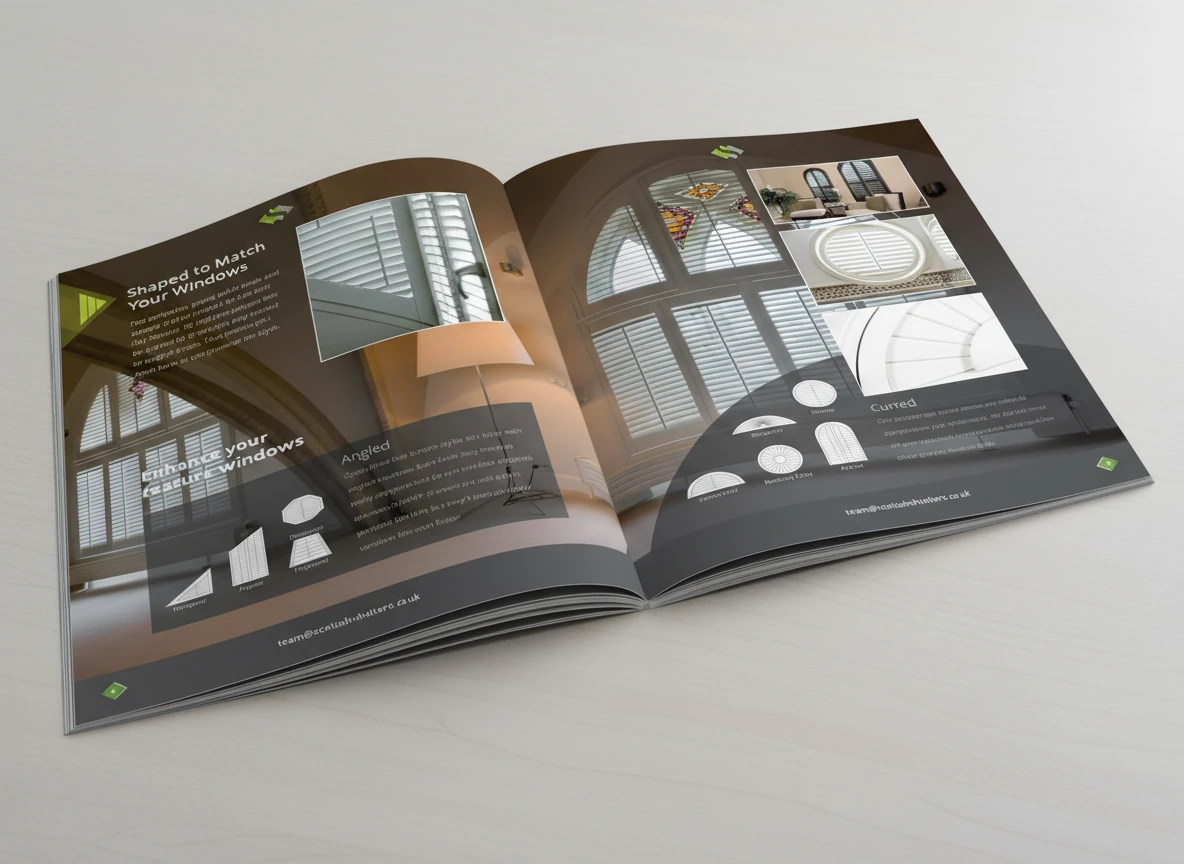
Request a brochure or arrange a no obligation consultation.