

Should a Blind Sit Close to the Glass, or Away From It?
There’s an assumption about blinds and heat that comes up again and again, and it sounds entirely sensible until you look at what is actually going on.
It runs like this. If a blind is going to sit out from the window rather than tucked tight against the glass, surely that just leaves a bigger pocket of air behind it to warm up?
It’s the wrong way round. The gap behind a blind isn’t a reservoir waiting to get hot. It’s the route the heat escapes by.
What actually happens behind a blind
When sunlight hits a blind, the blind reflects some of that energy straight back into the glass, and the air between the two warms up.
Neither of those matters much on its own. What decides whether the heat becomes significant is whether that warmed air has anywhere to go.
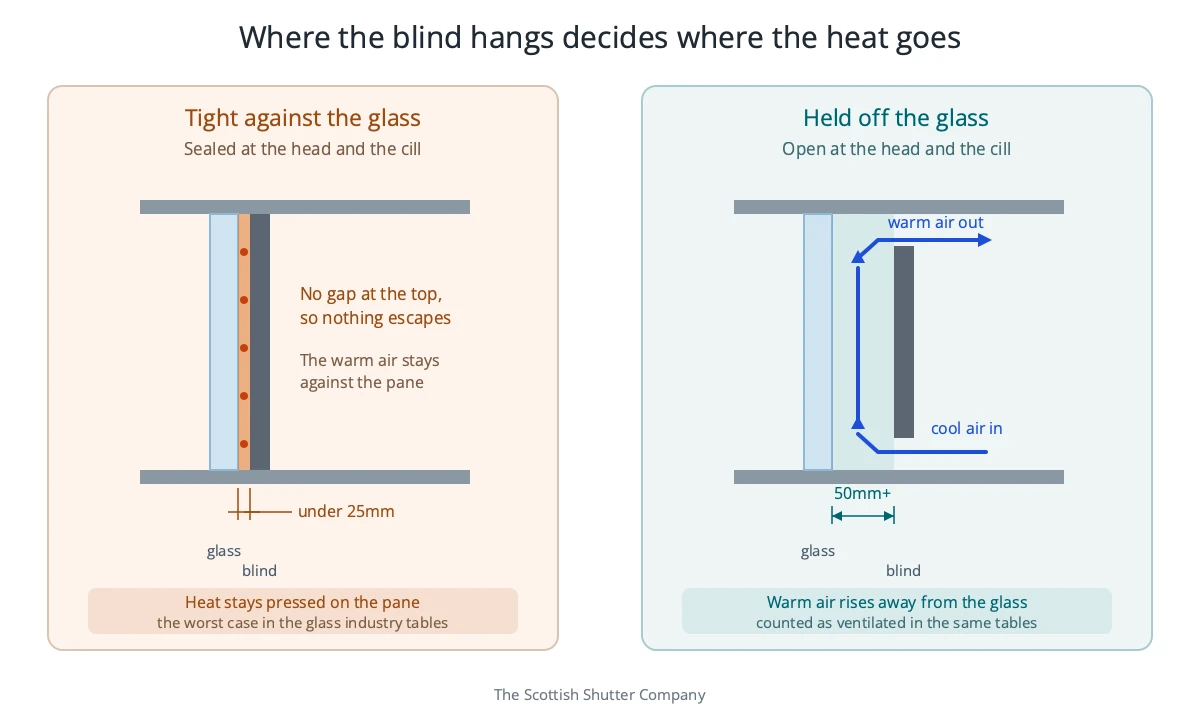
Given room above and below the blind, and some distance between fabric and glass, warm air rises out of the top of the space and cooler air is drawn in at the bottom to replace it. It is the same self driving cycle we wrote about in why glazed rooms overheat, operating over a few inches rather than a whole room.
Press the blind tight against the glass and you close that route off. The heat has nowhere to rise to, so it stays against the pane, which is precisely where you least want it.
The glass industry puts numbers on this
This is not our opinion. Glass manufacturers have to assess the risk of thermal stress, which is what happens when one part of a pane gets much hotter than another, and internal blinds are a recognised part of that assessment.
Saint Gobain’s technical guidance on the influence of blinds sets it out plainly. With sufficient gaps at the top and bottom of the blinds, it says, as well as distance from the glazing, warm air can rise out from the space and will not build up to the same extent behind the glazing.
The guidance then sorts blinds into three categories based on three measurements: the distance from the glass, the gap at the bottom, and the gap at the top.
- Ventilated: all three are 50mm or more
- Unventilated: all three are 25mm or more
- Blackout: any one of them is under 25mm
Each category carries a temperature figure that gets added to the calculation. For a light coloured blind on modern well insulated glazing, the ventilated case adds 6 degrees. The same blind sitting tight against the glass adds 25 degrees.
Over four times the thermal load, from nothing more than where the blind hangs.
Pilkington’s guidance for preventing thermal stress breakage reaches the same place independently, and asks for blinds to be placed two inches from the glass, vented top and bottom. Two inches is close enough to 50mm to be the same instruction.
Pilkington also names the culprit most people would assume was the safe option. Drop ceilings and blind pockets, it says, can act as heat traps. A tight enclosure around a blind is the problem, not the protection.
A second finding in the same guidance catches people out. Light coloured blinds reflect more solar energy back into the glass than dark ones, so a white or ivory blind is slightly harder on the glass than a dark one in the same position. It rarely changes what we recommend, but the two are connected.
What this means when you are choosing blinds
Where you have a choice, further from the glass is better, not worse. On a deep reveal, mounting on the wall face rather than inside the recess gives the air more room to move. It is worth asking the question on gable and apex windows in particular, where the mounting position is often open to discussion anyway.
Room darkening fabric deserves more thought than a translucent one. The light blocking comes from a metallised lining that also stops air passing through the cloth, so the blind can only breathe around its edges. Our guide to blackout versus room darkening covers the difference.
Do not add a second layer over the top. A closed curtain over an already closed blind turns a manageable cavity into a sealed one.
What this does not mean
If you already have blinds close to your glass, this is not a reason to have them taken out.
That guidance is written for assessing a new installation, on annealed glass, in the worst conditions a building might see. Most homes never approach it, and plenty of blinds sit close to glass causing nobody any trouble.
Blinds made to fit close to the glass are also designed with this in mind, and they leave gaps at the top, the bottom and both sides. It is why a room darkening blind mounted on the glass still shows a line of light around its edges. That light is the giveaway. Where light gets through, so does air, and the same industry guidance counts gaps at the sides as a ventilation route in their own right, not just gaps above and below.
So the edge light that people sometimes ask us to eliminate is doing a job. It is the blind breathing.
The proportionate response on a genuinely hot day is not to close the blind down to the last inch. Leave it slightly open so the warm air can get out. On our roof and lantern shading we advise a gap of around 30mm for that reason, and it is why those blinds are mounted at the ceiling line, as far from the glass as we can put them.
The short version
- The gap behind a blind is an escape route for heat, not a store of it
- Distance from the glass, plus gaps top and bottom, is what lets warm air rise away
- Glass industry guidance treats 50mm as the ventilated case and under 25mm as the worst one
- Room darkening fabric cannot breathe through itself, so its edges matter more
- On a hot day, leave the blind slightly open rather than fully closed
This is one of those details that never shows up in a brochure and makes a real difference to how a room behaves in August. If you have a glazed gable, a roof lantern or a south facing room that is hard to use in summer, we have spent nearly 40 years on exactly these windows.
Request a brochure or book a consultation at our Edinburgh Design Studio, and we will give you the whole picture rather than just the part that sells a blind. Our new Dundee Design Studio opens in autumn 2026.
Frequently asked questions
Can heat from the sun crack a window behind a blind? Thermal stress breakage is a recognised risk in the glass industry, and internal blinds are part of how manufacturers assess it, because a blind reflects heat back into the pane and traps warm air against it. In ordinary homes it is uncommon, but it is the reason guidance exists on how blinds should be mounted.
How far should a blind be from the glass? Glass industry guidance treats 50mm, or about two inches, as the point at which a blind counts as ventilated, provided there are similar gaps above and below it. Under 25mm is treated as the worst case for heat build up.
Do room darkening blinds make heat build up worse? They can, because the metallised lining that blocks the light also stops air passing through the fabric. The blind can only ventilate around its edges, so the gaps at the top, bottom and sides matter more than they would with a translucent cloth.
Should I leave a gap at the top and bottom of my blind? Yes, where the design allows it. Warm air needs to enter low and leave high, so a gap at only one end does not achieve much on its own. On roof and lantern blinds we recommend leaving around 30mm open on hot sunny days.
Are light coloured blinds cooler than dark ones? For the room, a light blind reflects more heat away and generally helps. For the glass itself, that reflected energy goes back into the pane, so light blinds carry a slightly higher thermal stress figure than dark ones in the same position.
Inspired by what you've read?
Request a brochure or arrange a no obligation consultation.