Cellular Fabrics for Shaped Gable Windows and Large Blinds
Why not all honeycomb fabrics are equal – and how to choose the right one for your project
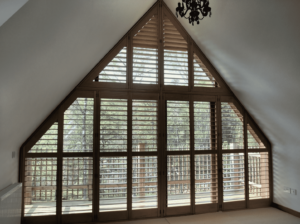
If you have a large rectangular window or a shaped gable, you quickly discover that not every blind on the market is truly up to the job. Cellular fabrics (sometimes called honeycomb or Duette®) can be outstanding here – but only if you use the right fabric, in the right pleat size, from the right
manufacturer.
This page explains our view, based on almost 40 years of working with cellular blinds across Scotland, including some very large and very awkward shaped windows.
What a Cellular (Honeycomb) Fabric Actually Does
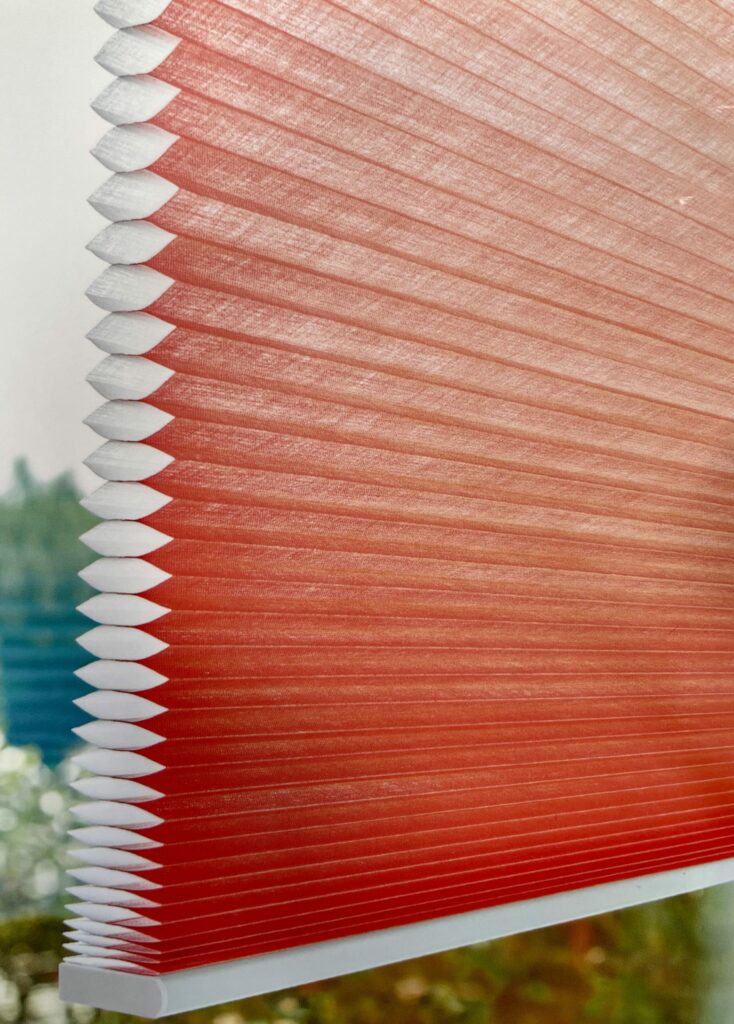
A cellular fabric is made from two or more layers of fabric joined together to form horizontal tubes or “cells”. When you look at it from the side, it looks like a honeycomb.
Those air pockets:
- Help keep heat out in summer
- Help keep heat in during winter
- Soften echo in rooms with hard floors and lots of glass
- Diffuse daylight and reduce glare
In principle, that makes a cellular blind a brilliant choice for tall or shaped windows. In practice, not all cellular fabrics are created equal, and that matters a great deal on big spans and gables.
Duette® – The Original Cellular Fabric
The modern cellular story really starts with Duette®, a proprietary honeycomb fabric developed by Hunter Douglas, one of the world’s leading window shading manufacturers.
In the UK, Duette® is normally sold under the Luxaflex® brand. Luxaflex® is a wholly owned part of Hunter Douglas, which is why you often see the two names together.
We have been supplying genuine Duette® via Luxaflex® for almost 40 years, and it is still our technical benchmark. When you see us talk about Unix and Elan, these are specific Duette® fabric ranges:
- Duette® Unix – a clean, understated Duette® fabric that offers excellent insulation and light control with a straightforward look.
- Duette® Elan – a more premium Duette® fabric with a richer texture, a broader colour range and slightly higher acoustic and thermal performance.
If a job justifies Duette® and the budget allows, Unix and Elan are still our “gold standard” fabrics for large and shaped cellular blinds.
Why We Do Not Use Cheap 25mm Cellular Fabrics
Many low-cost cellular blinds you see online or in high street offers are:
- Made in a narrow 25mm pleat
- Manufactured in bulk in South East Asia
- Sold under various brand names, often with very limited technical information
The problem is not just where they come from, it is how they are constructed. The most critical part of a cellular fabric is the bond line – the adhesive line that holds each tube together. If that adhesive is poor quality or not properly protected against ultraviolet
light, the cells can start to split open over time.
Once bond lines begin to fail:
- The pleats lose their shape
- The blind begins to sag, twist and “wander”
- The insulating air pockets are compromised
We have seen enough examples of this over the years to be extremely wary of specifying cheap 25mm cellular fabrics, especially on:
- Large rectangular blinds
- Anything with a drop over about 1,800mm
- Any shaped blind, particularly big gables
On smaller, standard windows, some of these fabrics may be acceptable for a while. On large or shaped blinds they are, in our view, a false economy.
Why Pleat Size Matters – Our 32mm Rule
Cellular fabrics are available in different pleat widths – 20mm, 25mm, 32mm, 45mm and sometimes 64mm. Many companies default to 25mm for almost everything, because it looks neat on a small sample card and fits easily into compact headrails.
Our experience is different. On big or shaped blinds, a deeper pleat simply behaves better.
Our rule of thumb is very clear:
- 32mm pleat is mandatory for all shaped blinds.
- 32mm pleat is mandatory for all rectangular blinds with a drop greater than 1,800mm.
Compared with 25mm, a 32mm cellular fabric:
- Has more “body” and is less prone to twisting or “walking” sideways
- Shows less of the internal cords and ladders when light shines through
- Is more forgiving when cut along a gable slope or other sharp angles
If you have been offered a 25mm cellular blind for a big gable or a very tall window, it is worth asking the supplier why they are not using a deeper pleat.
Why Shaped Cellular Blinds Must Be Made From Non-Woven Fabric
All cellular (honeycomb) fabrics may look similar at first glance, but they are not all constructed in the same way. Broadly speaking, they fall into two categories: non-woven and woven. This distinction is absolutely critical when it comes to shaped blinds such as
gables, triangles and trapezoids.
Non-woven cellular fabrics – essential for shaped blinds
Non-woven cellular fabrics are made from bonded layers of polyester that are:
- Heat-set and dimensionally stable
- Able to be cut at angles without fraying
- Able to hold sharp geometric lines
- Structurally strong at the bond lines between each cell
This is why all properly engineered shaped cellular blinds must use non-woven fabrics. Both of the translucent cellular systems we specify for shaped blinds:
- Hunter Douglas Duette (Unix & Elan)
- Coulisse Honeycell (Palma & True Rioja)
are non-woven fabrics, which is what allows them to be safely and accurately fabricated into:
- Gables
- Triangles
- Trapezoids
- Other irregular architectural shapes
without distortion or premature failure.
Why woven cellular fabrics are not suitable for shaped blinds
Woven cellular fabrics are made from interlaced threads, more like a traditional textile. They can look very attractive on standard rectangular blinds, but they have two major limitations when used on shaped windows:
- The cut edges at angles are far more prone to fraying and distortion
- The fabric has directional stretch, which makes it difficult to maintain crisp geometry in a shape
For these reasons, woven cellular fabrics are not suitable for shaped blinds, regardless of how they appear in a brochure. This is also why certain decorative sheer fabrics (such as some Batiste / Batiste Sheer styles) are not fabrics we will specify for gables or other shaped
applications.
Important technical rule:
All shaped cellular blinds must be manufactured from non-woven honeycomb fabric. Woven cellular fabrics are not structurally suitable for gables or other shaped windows and are therefore not options we will specify for these applications.
Luxaflex®, MasterBlinds and Size Limits
You may have already been told that Duette® is “not available” for certain large sizes or shapes. A few years ago Luxaflex® moved much of their Duette® production back to Germany and, at the same time, introduced tighter maximum sizes on some models.
That change was a commercial decision, not a failure of the fabric or the technology. The Duette® fabrics and components can still handle very large blinds and complex shapes, but Luxaflex® UK now chooses not to offer some of those combinations directly.
For those bigger and more complicated jobs we work with MasterBlinds in London, an independent specialist who fabricates blinds using the full Hunter Douglas Duette® component and fabric range, not just the subset that appears on the current Luxaflex® price list.
In practical terms:
- Everyday Duette® blinds will usually come to you via Luxaflex®.
- Large, awkward or shaped Duette® blinds are typically made for us by MasterBlinds using Hunter Douglas systems.
You still get genuine Duette® fabric; we simply use the fabrication route that allows us to say “yes” more often.
Why We Also Offer Coulisse Honeycell Fabrics
Given everything above, you might wonder why we use anything other than Duette® at all. There are two main reasons:
- Budget: Duette® is a premium European fabric. Sometimes the ideal technical answer is simply beyond the available budget.
- Sustainability and choice: there are now a small number of non–Hunter Douglas fabrics that genuinely meet our standards.
After a lot of research, we chose to add a very carefully selected range of Coulisse Honeycell fabrics, made by Coulisse in the Netherlands.
The Coulisse Honeycell fabrics we use for large and shaped blinds include:
- Palma Translucent – semi-transparent Honeycell fabric in a curated palette of colours.
- Palma Room Darkening – matching black-out versions for stronger light control.
- True Rioja 32mm – translucent and room-darkening cellular fabrics (we will add full details here once the current colour card has been digitised).
Coulisse Honeycell fabrics are:
- 100% polyester, PVC-free
- Manufactured to Oeko-Tex® Standard 100 (tested for harmful substances)
- Available in 32mm pleat sizes on the key articles we use
- Designed to offer genuine thermal and acoustic benefits
Structurally and environmentally, they behave like a “grown-up” cellular fabric should, while typically coming in below Duette® on price.
How the Costs Typically Compare
Exact prices always depend on the size of your window, the control system and other details, but for a typical shaped gable project we often see something like this:
- Coulisse Honeycell option – usually our most economical choice.
- Duette® Unix – roughly 10% more than the Coulisse option.
- Duette® Elan – roughly another 10% more than Unix (around 20% above the Coulisse option overall).
By the time you are looking at a large gable or a very big rectangular blind, most of the cost is in the size, shape, hardware and skilled installation. The fabric choice does move the price, but not as dramatically as many people expect.
Coulisse “Palma” Translucent – Our Current Range
For shaped and large blinds, 32mm Palma is our standard Coulisse Honeycell fabric. The table below shows the Palma Translucent colours we have access to via MasterBlinds, the pleat sizes they are made in, and which ones are available in 32mm for use on large rectangular and shaped blinds.
| Range | Colour name | Code | 20mm | 25mm | 32mm | 45mm | Suitable in 32mm for large / shaped blinds? |
|---|---|---|---|---|---|---|---|
| Palma Translucent | Sand | 7413 | Yes | Yes | No | No | No |
| Palma Translucent | Pearl | 7411 | Yes | Yes | No | No | No |
| Palma Translucent | Cream | 7412 | No | Yes | No | No | No |
| Palma Translucent | Snow White | 7410 | Yes | Yes | Yes | Yes | Yes |
| Palma Translucent | Camel | 7414 | No | Yes | Yes | Yes | Yes |
| Palma Translucent | Dune | 7415 | Yes | Yes | No | No | No |
| Palma Translucent | Dawn | 7416 | No | Yes | Yes | Yes | Yes |
| Palma Translucent | Raven | 7420 | Yes | Yes | Yes | No | Yes |
| Palma Translucent | Iron | 7421 | No | Yes | No | Yes | No |
| Palma Translucent | Ash | 7417 | No | Yes | Yes | Yes | Yes |
| Palma Translucent | Mouse | 7423 | Yes | Yes | Yes | Yes | Yes |
| Palma Translucent | Cloud | 7424 | No | Yes | Yes | Yes | Yes |
| Palma Translucent | Steel | 7422 | No | Yes | No | No | No |
| Palma Translucent | Essence | 7438 | No | Yes | Yes | Yes | Yes |
| Palma Translucent | Dust | 741-06 | Yes | Yes | Yes | No | Yes |
| Palma Translucent | Jaffa | 7434 | No | Yes | Yes | Yes | Yes |
| Palma Translucent | Melon | 7437 | No | Yes | Yes | Yes | Yes |
| Palma Translucent | Mint | 741-03 | No | Yes | Yes | No | Yes |
| Palma Translucent | Grass | 7441 | No | Yes | No | No | No |
| Palma Translucent | Jeans | 7427 | No | Yes | Yes | No | Yes |
Although Palma Translucent is available in a wide colour palette, not every colour is manufactured in every cell size. For large and shaped blinds we will always guide you to the colours that are actually available, and structurally suitable, in 32mm.
Fabrics We Deliberately Avoid on Shaped Blinds
It is just as important to be clear about what we avoid. For shaped and very large blinds we normally refuse to use:
- Cheap 25mm cellular fabrics from unknown or unproven sources.
- Certain very delicate sheer decorative Duette® fabrics that are not robust enough for complex shapes.
These may look attractive on a small, straight sample blind. On a gable or a big span, in our experience, they are asking for trouble.
How We Help You Choose the Right Fabric
When you ask us to look at a large or shaped window, we will usually:
-
Assess the window and the room.
We look at orientation, overheating risk, privacy needs, floor finishes, acoustics and how you actually use the space. -
Decide whether Duette® or Coulisse is technically appropriate.
If your project calls for the very best performance or you prefer to stick with the original Duette® technology, we will talk you through Unix and Elan. If budget is tighter, or you like the sustainability story, we will also show you the appropriate Coulisse Honeycell options. -
Filter by what is structurally suitable.
For all shaped blinds, and all rectangular blinds with a drop over 1,800mm, we will only specify 32mm (or occasionally larger) fabrics. -
Then help you choose colour and texture.
Once we know the blind will work technically, you can choose the fabric that looks and feels right in your room.
Next Steps
If you would like us to look at a particular gable or large window, we are very happy to help. Our Dundee and Edinburgh design studios are open by appointment only, so that you have the complete and undivided attention of one of our shading specialists for the duration of your visit.
We also offer home visits and virtual consultations. You can arrange an appointment by calling 0800 086 2989.